
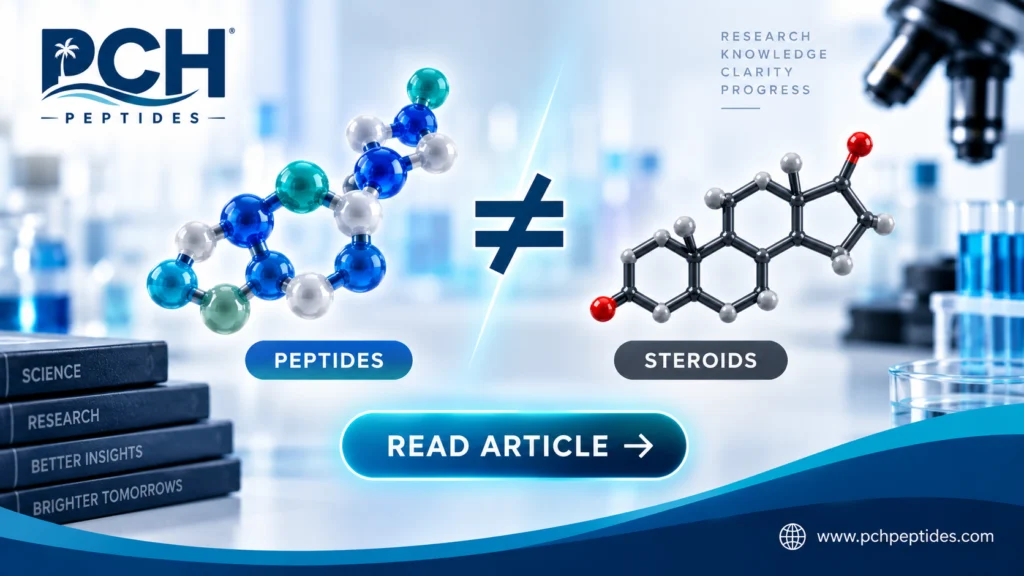
Are peptides steroids is one of the most common misconceptions in this entire field, and it’s an understandable one. Both terms show up constantly in the same conversations, often used almost interchangeably by people who aren’t familiar with the underlying science. This article breaks down what actually separates peptides from steroids, why the confusion exists in the first place, and what each category actually means from a scientific standpoint.
The Short Answer
No, peptides are not steroids. They belong to entirely different chemical classes, are built from completely different molecular components, and are studied through different areas of biochemistry. The confusion comes almost entirely from how these terms are used casually in fitness and wellness conversations, not from any actual chemical overlap.
What Makes a Peptide a Peptide
To understand why peptides and steroids are different, it helps to start with a clear definition of each.
The Basic Structure of a Peptide
A peptide is a short chain of amino acids linked together by peptide bonds. Amino acids are organic compounds that serve as the fundamental building blocks of biological molecules, and when a relatively small number of them, generally two to fifty, are joined in sequence, the result is classified as a peptide.
Why Peptides Are Classified as Amino Acid Compounds
This amino acid based structure is the defining feature of every peptide, regardless of its specific research application. Whether a compound is being studied in connection with cellular pathways, metabolic research, or receptor interaction, its classification as a peptide comes down to this same underlying chemistry.
What Makes a Steroid a Steroid
Steroids belong to an entirely separate category of molecules, built around a completely different chemical foundation.
The Basic Structure of a Steroid
Steroids are organic compounds characterized by a specific four-ring carbon structure. This ring-based framework is fundamentally different from the linear amino acid chains that define a peptide, and it’s the reason these two categories are classified separately in biochemistry.
Common Categories of Steroid Compounds
Steroids include a wide range of naturally occurring and synthetic compounds, including cholesterol, corticosteroids, and anabolic-androgenic steroids. Anabolic steroids specifically are synthetic derivatives related to testosterone, and they are the compounds most people are actually thinking of when this misconception comes up.
Why the Confusion Happens
Understanding where this misconception comes from helps explain why it persists so widely.
Overlapping Conversations in Fitness Communities
Peptides and anabolic steroids often get discussed in the same online spaces, frequently in conversations about physical performance and recovery. Because both categories show up in similar discussions, they end up mentally grouped together, even though the underlying chemistry has nothing in common.
Similar Marketing and Sourcing Channels
Some of the same gray-market vendors that have historically sold anabolic steroids have also sold peptides, which reinforces the perception that these are related product categories. This is a marketing and distribution overlap, not a chemical one.
Misuse of the Term “Hormone”
Some peptides are studied in connection with hormone related signaling pathways, since certain hormones are themselves peptides. Compounds like growth hormone releasing hormone analogs fall into this category. This connection to hormone related research sometimes gets conflated with anabolic steroids, which are also hormone derived, but the two remain structurally distinct classes of molecules.
Key Differences Between Peptides and Steroids
Laying these differences out directly makes the distinction much clearer.
Chemical Structure
Peptides are built from linear chains of amino acids. Steroids are built from a four-ring carbon structure. These are fundamentally different molecular architectures, not variations of the same underlying chemistry.
Biological Origin and Classification
Peptides occur throughout biology as signaling molecules, structural components, and enzymatic participants. Steroids are a distinct class that includes cholesterol derivatives, hormones, and related compounds, classified based on their shared ring structure rather than their biological function.
Regulatory Classification
Anabolic steroids are classified as controlled substances under federal law due to their potential for misuse. Peptides, as a category, are not controlled substances. Legality for peptides depends instead on how a specific compound is sold and labeled, particularly whether it’s marketed for legitimate laboratory research or implies human use. For a deeper look at this distinction, see our guide on what determines whether research peptides are legal.
Are Any Peptides Related to Steroids
While peptides and steroids are structurally distinct, it’s worth addressing a related question directly.
Peptide Hormones vs Steroid Hormones
Some hormones in the body are peptides, and some are steroids, which is likely where part of the confusion originates. Insulin, for example, is a peptide hormone, while testosterone is a steroid hormone. Both are hormones, but they belong to entirely different chemical classes, built through entirely different biosynthetic pathways.
Why This Distinction Matters for Research
Understanding this separation matters for anyone studying either category, since the mechanisms, structures, and laboratory methods used to characterize a peptide hormone are different from those used for a steroid hormone. Grouping them together as if they’re interchangeable overlooks meaningful differences that actually matter at a research level.
What This Means for Research Peptide Sourcing
Because peptides and steroids are regulated differently and sold through different channels, it’s worth being clear about what a research peptide supplier actually provides.
PCH Peptides Supplies Research Peptides, Not Steroids
PCH Peptides operates strictly within the peptide category, supplying laboratory research materials like BPC-157, TB-500, and CJC-1295 No DAC. These are amino acid based compounds studied for laboratory research purposes, not steroid compounds, and not controlled substances.
Documentation Still Matters
Regardless of category, verifying what you’re actually receiving matters. PCH Peptides maintains batch-specific documentation across its research peptide catalog, available through the COA Library, giving researchers a way to confirm identity and purity before use.
Learn More About Research Peptide Classification
For a broader understanding of how research peptides are classified and regulated, explore our guide on RUO peptides, or browse our overview of commonly studied research peptides to see the range of compounds available. The full research peptide catalog is available for researchers looking to source materials directly.
Research Use Only Disclaimer
This article is provided for general educational purposes only. All products sold by PCH Peptides are supplied strictly for laboratory, academic, or institutional research purposes and are not intended for human or animal consumption, injection, or any therapeutic use. No dosage guidance, protocols, or claims of health, wellness, or performance outcomes are provided anywhere on this site.
Frequently Asked Questions
Are peptides steroids?
No. Peptides are chains of amino acids, while steroids are built from a distinct four-ring carbon structure. They belong to entirely different chemical classes.
Why do people confuse peptides with steroids?
The confusion mostly comes from overlapping conversations in fitness communities and shared gray-market sourcing channels, not from any actual chemical similarity.
Are peptides controlled substances like anabolic steroids?
No. Anabolic steroids are federally controlled substances. Peptides are not classified as controlled substances, though their legal sale depends on proper research use only labeling.
Are any hormones both peptides and steroids?
No single hormone belongs to both categories, but the body does produce both peptide hormones, like insulin, and steroid hormones, like testosterone, which are structurally distinct from one another.
Does PCH Peptides sell steroids?
No. PCH Peptides supplies research peptides only, intended strictly for laboratory research, not steroid compounds of any kind.
How can I verify what category a specific compound falls into?
Reviewing the compound’s molecular structure and classification through its Certificate of Analysis or scientific literature is the most reliable way to confirm whether it’s a peptide or a steroid.