
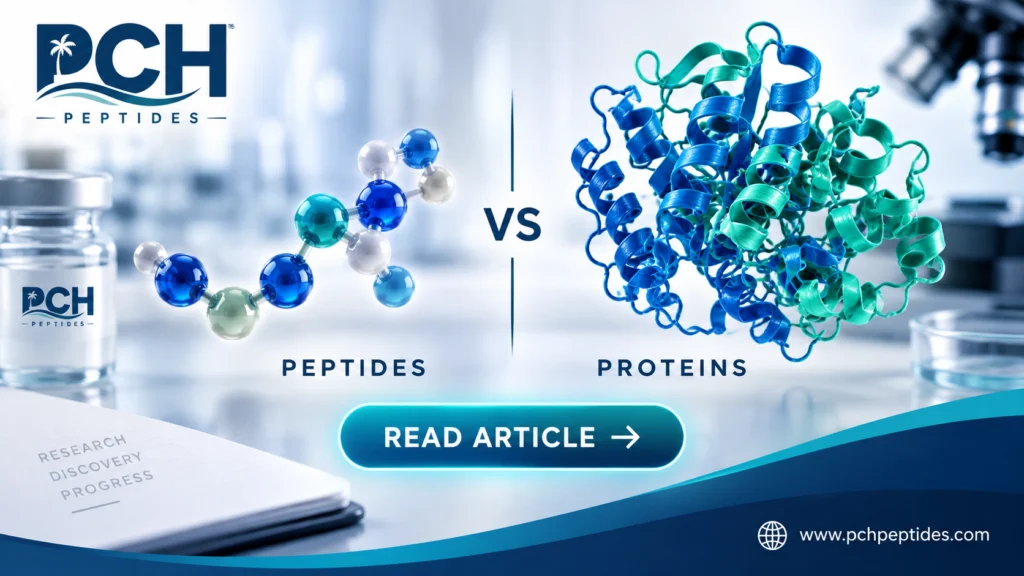
Peptides and proteins are both built from amino acids, yet the two terms are not interchangeable. Their differences in size, structural complexity, stability, folding, and biological behavior can significantly influence how scientists study them in the laboratory.
Understanding peptides vs proteins is especially important in biochemical research because both molecular classes participate in signaling, metabolism, structural support, enzyme activity, transport, and cellular communication. A short peptide may act as a signaling molecule, while a much larger protein may function as an enzyme or structural component containing hundreds of amino acids.
The distinction is not always defined by one absolute numerical cutoff. Instead, scientists generally describe peptides as shorter amino-acid chains and proteins as larger, more structurally complex molecules that typically fold into defined three-dimensional shapes.
For researchers working with peptide materials, understanding this difference can help with experimental design, analytical testing, stability assessment, and interpretation of results. PCH Peptides supplies peptide materials strictly for laboratory, academic, analytical, and institutional research.
What Are Peptides?
Peptides are chains of amino acids connected through peptide bonds.
A peptide bond forms when the carboxyl group of one amino acid joins with the amino group of another. This process creates a repeating molecular backbone that allows amino acids to form chains of different lengths.
Peptides can contain only a few amino acids or several dozen.
Common Peptide Classifications
Researchers sometimes describe peptides according to their length.
Examples include:
- Dipeptides containing two amino acids
- Tripeptides containing three amino acids
- Oligopeptides containing a relatively small number of amino acids
- Polypeptides containing longer amino-acid chains
The terminology can vary between scientific fields, so researchers should focus on the exact amino-acid sequence rather than relying only on a broad category name.
GHK as a Simple Peptide Example
GHK is a useful example of a very short peptide.
GHK stands for glycyl-L-histidyl-L-lysine and consists of only three amino acids. When it binds copper, it forms the GHK-Cu copper peptide complex.
Researchers studying short peptide chemistry can review the GHK-Cu research material available through PCH Peptides.
Its small size makes GHK-Cu very different from large proteins containing hundreds of amino acids.
What Are Proteins?
Proteins are amino-acid chains that generally contain more residues and develop more complex three-dimensional structures than typical peptides.
A protein’s amino-acid sequence determines how it folds, and this folded structure is often essential to its biological function.
Proteins can serve as:
- Enzymes
- Structural components
- Receptors
- Transporters
- Antibodies
- Channels
- Molecular motors
- Regulatory factors
Some proteins consist of a single polypeptide chain, while others contain several chains assembled into a larger molecular complex.
Protein Folding Creates Functional Structure
The function of many proteins depends on their ability to fold correctly.
Proteins can form structures such as alpha helices, beta sheets, loops, domains, and multi-subunit complexes.
These structures allow proteins to bind other molecules, catalyze reactions, form cellular scaffolds, or transport substances.
Misfolding Can Change Protein Function
If a protein does not fold correctly, its function may change or disappear.
This is one reason protein research often requires careful control of temperature, pH, ionic strength, and other environmental factors.
Peptides can also adopt defined conformations, but shorter peptide chains often have less complex folding behavior than large proteins.
Peptides vs Proteins: The Main Difference
The simplest distinction between peptides and proteins involves size and structural organization.
Peptides are generally shorter chains of amino acids, while proteins are usually larger chains that fold into more complex functional structures.
There is no universally accepted amino-acid number where a peptide suddenly becomes a protein. Different scientific sources may use slightly different conventions.
Peptides vs Proteins Comparison
| Research Feature | Peptides | Proteins |
| Building blocks | Amino acids | Amino acids |
| Chemical linkage | Peptide bonds | Peptide bonds |
| Typical size | Shorter chains | Longer chains |
| Structural complexity | Often lower | Usually higher |
| Folding | May have limited or defined conformation | Often complex 3D folding |
| Common research roles | Signaling, binding, pathway research | Enzymatic, structural, receptor, transport functions |
| Laboratory synthesis | Often chemical synthesis | Often recombinant production or biological expression |
| Analytical methods | HPLC, mass spectrometry, spectroscopy | Electrophoresis, chromatography, mass spectrometry, structural methods |
The important point is that peptides and proteins exist on a continuum rather than being separated by one universal molecular cutoff.
Amino-Acid Sequence Still Matters Most
Length alone does not determine biological function.
Two peptides with similar numbers of amino acids can behave completely differently because their sequences differ.
Likewise, two proteins of similar size can have entirely different functions.
Sequence Determines Molecular Identity
Researchers should always identify an experimental material by its exact sequence, molecular structure, and relevant modifications.
Broad labels such as “peptide” or “protein” provide useful classification, but they do not define the complete molecule.
How Peptides and Proteins Are Made
Peptides and proteins may be produced naturally inside cells, but research materials can also be created through laboratory methods.
The production technique often depends on molecular size and complexity.
Peptide Synthesis
Many research peptides are produced through chemical synthesis.
Solid-phase peptide synthesis is a widely used technique in which amino acids are added sequentially to build a defined peptide chain.
This approach can be useful for producing relatively short sequences with precise molecular identities.
Synthetic Research Peptides
Examples of synthetic peptide research materials include BPC-157 and several other compounds studied in biochemical research.
PCH Peptides supplies BPC-157 10 mg research material as a synthetic pentadecapeptide consisting of 15 amino acids.
Its relatively short amino-acid sequence places it clearly within the peptide category rather than the typical protein category.
Protein Production
Large proteins can be difficult to manufacture efficiently through straightforward chemical synthesis.
Researchers therefore often use recombinant expression systems.
A gene encoding the desired protein can be introduced into bacteria, yeast, mammalian cells, or another expression system. Those cells then produce the protein.
Recombinant Production Adds Complexity
Producing a protein is not always as simple as generating its amino-acid sequence.
Researchers may need to consider:
- Folding
- Disulfide bond formation
- Glycosylation
- Phosphorylation
- Protein cleavage
- Subunit assembly
- Cellular localization
These variables are especially important for proteins whose function depends on post-translational modification.
Why Molecular Size Matters in Research
The difference between peptides and proteins affects how researchers handle, analyze, and characterize them.
Smaller molecules may behave differently from large folded proteins in solution.
Stability Differences
Short peptides can sometimes be easier to characterize chemically, but they may still be susceptible to degradation.
Temperature, moisture, oxidation, light, enzymes, pH, and storage conditions can affect peptide stability.
Proteins may face additional challenges because environmental changes can disrupt their three-dimensional folding.
Denaturation Is Particularly Important for Proteins
Protein denaturation occurs when a protein loses its organized three-dimensional structure.
Heat, extreme pH, solvents, and other conditions can cause denaturation.
A denatured protein may retain its amino-acid sequence while losing its normal function because the required shape is no longer present.
Peptides as Signaling Molecules
One reason peptides receive substantial research attention is their role in biological communication.
Many naturally occurring peptides function as signaling molecules.
They can interact with receptors or influence pathways associated with metabolism, cellular communication, growth, stress responses, and other biological systems.
Mitochondrial-Derived Peptides
Some peptides originate from genetic material located within mitochondria.
MOTS-C is one example.
MOTS-C is a 16-amino-acid mitochondrial-derived peptide studied in connection with cellular energy metabolism and metabolic signaling.
Researchers interested in this area can review the MOTS-C 10 mg research listing from PCH Peptides.
Research Peptides Can Have Very Different Origins
Not all research peptides are produced or classified in the same way.
Some are based on naturally occurring sequences, while others are synthetic analogs or modified peptide structures.
This makes precise molecular identification important.
Proteins Perform Broader Structural and Enzymatic Roles
Although peptides can participate in complex signaling processes, proteins commonly perform functions that depend heavily on larger three-dimensional structures.
Enzymes provide one of the clearest examples.
Proteins as Enzymes
Enzymes catalyze biochemical reactions.
Their folded structures create active sites where specific molecules can bind.
A change in protein folding can alter the shape of the active site and interfere with enzyme activity.
Peptides Can Also Influence Enzymatic Systems
Peptides do not need to function as enzymes to affect enzyme-related pathways.
A peptide may bind a receptor, interact with another protein, coordinate a metal, or influence a signaling pathway that ultimately changes enzyme activity.
This illustrates why peptide research and protein research often overlap.
Structural Levels in Proteins
Protein structure is frequently described at four levels.
Understanding these levels helps explain why proteins generally have greater structural complexity than shorter peptides.
Primary and Secondary Structure
Primary structure refers to the amino-acid sequence.
Secondary structure refers to localized folding patterns such as alpha helices and beta sheets.
Sequence Comes First
Both peptides and proteins have primary structure because both consist of amino-acid sequences.
The distinction becomes more noticeable as larger chains develop increasingly organized folding.
Tertiary and Quaternary Structure
Tertiary structure refers to the overall three-dimensional shape of a single polypeptide chain.
Quaternary structure refers to complexes formed when multiple protein chains assemble together.
Not Every Protein Has Quaternary Structure
A protein with only one functional polypeptide chain may not have quaternary structure.
Multi-subunit proteins, however, can depend on precise interactions between several chains.
How Researchers Analyze Peptides and Proteins
Laboratory scientists use several techniques to characterize peptides and proteins.
The appropriate method depends on molecular size, structure, purity, and research objective.
High-Performance Liquid Chromatography
High-performance liquid chromatography, commonly called HPLC, is widely used for peptide characterization.
It can help researchers separate components and evaluate chromatographic purity.
Purity Is Not the Same as Identity
A purity percentage alone does not fully confirm what a molecule is.
Researchers may combine chromatography with mass spectrometry or other analytical techniques for stronger molecular characterization.
Mass Spectrometry
Mass spectrometry measures mass-to-charge characteristics and can provide information about molecular identity.
It is widely used in both peptide and protein research.
Large proteins may require specialized workflows because of their size and complexity.
Multiple Analytical Methods Can Strengthen Research
Using complementary analytical techniques can help researchers verify:
- Molecular identity
- Purity
- Sequence
- Molecular mass
- Modifications
- Sample consistency
PCH Peptides provides available batch documentation through its COA Library.
Why Certificates of Analysis Matter for Research Peptides
Researchers need confidence that the material listed on a vial corresponds to the material described in project documentation.
A Certificate of Analysis can provide batch-specific analytical information.
Information Researchers May Review
Depending on the material, a COA can include information about:
- Product identity
- Batch or lot number
- Purity
- Analytical methodology
- Molecular characterization
- Testing date
Batch Traceability Supports Reproducibility
Researchers should match analytical documentation to the batch used in their experiment.
This becomes particularly important when a project is repeated months later or compared between laboratories.
Current Research Peptide Costs at PCH Peptides
Laboratory procurement planning often involves balancing research configuration, molecular identity, documentation, and cost.
At the time this article was prepared, PCH Peptides listed GHK-Cu 50 mg at $40 for controlled research.
Its BPC-157 10 mg research material was listed at $50, while MOTS-C 10 mg was listed at $60.
Researchers should check the individual live product pages before preparing procurement documentation because pricing and availability can change.
For laboratories comparing a wider range of compounds, the PCH Peptides research catalog provides current product listings.
Why These Examples Help Explain Peptide Diversity
GHK-Cu, BPC-157, and MOTS-C are all classified as peptide research materials, yet they differ substantially.
GHK is a three-amino-acid sequence that can coordinate copper. BPC-157 is a 15-amino-acid synthetic pentadecapeptide. MOTS-C is a 16-amino-acid mitochondrial-derived peptide.
The Word “Peptide” Covers Many Molecular Types
This diversity shows why researchers should not assume that two molecules behave similarly simply because both are peptides.
Sequence, length, modification, molecular interactions, and experimental context all matter.
Peptides vs Proteins in Laboratory Research
The difference between peptides and proteins can affect experimental planning.
Shorter peptides may be useful for studying receptor interactions, binding behavior, signaling pathways, or structure-activity relationships.
Proteins may be studied for enzyme function, structural biology, receptor activity, antibody interactions, transport, or complex molecular assemblies.
Experimental Controls Should Match the Molecule
A peptide experiment may require controls related to sequence, concentration, carrier, metal binding, or peptide modification.
Protein experiments may additionally require controls for folding state, subunit assembly, or post-translational modifications.
A Good Study Begins With Molecular Definition
Before testing any material, researchers should clearly document:
- Molecular name
- Amino-acid sequence
- Molecular mass
- Modifications
- Purity
- Batch information
- Storage requirements
- Experimental model
Clear documentation improves reproducibility.
Common Misconceptions About Peptides and Proteins
Peptide terminology is often simplified in online discussions, leading to several misconceptions.
Misconception: All Small Proteins Are Peptides
There is no single universally agreed cutoff separating peptides from proteins.
Some molecules occupy a gray area where terminology depends on scientific context.
Function and Folding Also Matter
Scientists often consider structural complexity and biological behavior in addition to amino-acid count.
Misconception: Peptides Are Just Broken Proteins
Some peptides can result from protein cleavage, but many peptides have their own independent biological roles.
Cells can synthesize peptide signaling molecules specifically for defined functions.
Synthetic Peptides Add Another Category
Research laboratories can also produce defined synthetic peptides that are designed to study particular structures or pathways.
These materials should be identified by their actual sequence rather than described simply as protein fragments.
Misconception: All Peptides Have Similar Functions
Peptides can differ dramatically.
A three-amino-acid copper-binding peptide and a mitochondrial-derived signaling peptide have completely different structures and research contexts.
The same principle applies to proteins.
Research Use Only Peptides
Research classification is important when discussing laboratory peptide materials.
PCH Peptides provides a dedicated guide explaining Research Use Only peptides.
What Research Use Only Means
RUO materials are supplied for laboratory, academic, institutional, analytical, or identification purposes.
They are not supplied as approved medicines or consumer products.
Research Classification Does Not Provide Human-Use Instructions
PCH Peptides does not provide human dosage guidance, administration protocols, therapeutic directions, cycles, stacks, or personal-use recommendations for its research peptide materials.
Researchers can explore the list of research peptides to compare different laboratory compounds and their research classifications.
Research Use Only Disclaimer
All peptide products referenced in this article are discussed strictly in the context of laboratory, academic, analytical, institutional, or preclinical research.
PCH Peptides products are supplied for Research Use Only and are not intended for human or animal consumption, injection, ingestion, diagnosis, treatment, prevention, performance enhancement, weight management, or therapeutic use.
Nothing in this article provides medical advice, human dosage information, administration instructions, reconstitution ratios, cycles, stacks, or treatment protocols.
Researchers should follow their institution’s established laboratory procedures, appropriate safety requirements, validated analytical methods, and applicable regulations.
Frequently Asked Questions About Peptides vs Proteins
What is the main difference between peptides and proteins?
Both consist of amino acids joined by peptide bonds. Peptides are generally shorter amino-acid chains, while proteins are typically larger and develop more complex three-dimensional structures.
How many amino acids make a peptide?
There is no universal cutoff accepted across every scientific discipline. Peptides generally contain relatively short amino-acid chains, while proteins are typically larger and more structurally complex.
Are peptides made from proteins?
Some peptides can be produced when larger proteins are enzymatically cleaved. Others are synthesized independently by cells or manufactured synthetically for laboratory research.
Are all proteins made from peptides?
Proteins consist of amino acids connected by peptide bonds, forming one or more polypeptide chains. In that chemical sense, peptide bonds form the backbone of proteins.
Is GHK-Cu a peptide or protein?
GHK-Cu is a copper peptide complex. Its peptide component, GHK, contains only three amino acids, making it far smaller than a typical protein.
Is BPC-157 a peptide or protein?
BPC-157 is a synthetic pentadecapeptide consisting of 15 amino acids. It is classified as a peptide rather than a protein.
Is MOTS-C a peptide?
Yes. MOTS-C is a 16-amino-acid mitochondrial-derived peptide studied in cellular energy and metabolic signaling research.
Why are proteins structurally more complex than peptides?
Larger amino-acid chains provide more opportunities for interactions that produce secondary, tertiary, and sometimes quaternary structures. These folded structures often determine protein function.
What does GHK-Cu cost for research?
At the time of writing, PCH Peptides listed GHK-Cu 50 mg at $40. Researchers should review the current GHK-Cu research listing because pricing and availability may change.
What does BPC-157 cost for research?
PCH Peptides currently lists BPC-157 10 mg at $50 for laboratory research. Current product details can be confirmed on the BPC-157 research page.
What does MOTS-C cost for research?
At the time this article was prepared, MOTS-C 10 mg was listed at $60. Researchers can check the MOTS-C research listing for current information.
Where can researchers learn more about peptides?
Researchers can explore the PCH Peptides research articles for additional educational information or use the PCH Peptides contact page for questions involving orders, product documentation, batch information, and research material availability.
Final Research Perspective
The peptides vs proteins distinction begins with a shared foundation: both are made from amino acids connected by peptide bonds.
Their differences emerge primarily through chain length, molecular complexity, folding, and biological function.
Peptides are generally shorter molecules that may participate in signaling, metal coordination, receptor interactions, metabolic pathways, or other specialized biological processes. Proteins tend to be larger and may form highly organized three-dimensional structures required for enzymatic, structural, transport, immune, or receptor functions.
The boundary is not absolute. Biology contains many molecules that fall between simple textbook categories, which is why researchers should focus on exact molecular identity rather than relying on amino-acid count alone.
For laboratory work, this distinction influences synthesis, analytical testing, stability studies, storage, experimental controls, and interpretation. A three-amino-acid copper-binding peptide such as GHK-Cu presents very different research considerations from a large folded protein with multiple functional domains.
PCH Peptides supplies a range of Research Use Only peptide materials with available batch documentation for controlled laboratory investigation. Researchers should evaluate each material according to its individual sequence, structure, purity, analytical record, and suitability for the planned experiment.
Ultimately, understanding how peptides differ from proteins provides a foundation for more precise biochemical research. Both molecular classes are essential to biological systems, but their size, structure, and behavior create very different research questions.