Research Use Only Disclaimer
IGF-LR3 is sold strictly for laboratory, academic and institutional research. It is not for human or animal consumption, injection, or any therapeutic, diagnostic or veterinary use. PCH Peptides does not provide dosage, administration or usage guidance.
What Is IGF-1 LR3?
IGF-1 LR3, also known as Long R3 IGF-1, is a synthetic analogue of human insulin-like growth factor 1 (IGF-1), a naturally occurring peptide growth factor involved in cellular signalling.
Native human IGF-1 consists of 70 amino acids, whereas IGF-1 LR3 contains 83 amino acids due to two structural modifications.
The first modification replaces glutamic acid with arginine at position 3, commonly referred to as the R3 substitution.
The second modification adds a 13-amino-acid extension to the N-terminus, increasing the total peptide length to 83 residues.
These structural changes reduce the analogue’s affinity for certain insulin-like growth factor-binding proteins (IGFBPs), which can alter its availability for interaction with the IGF-1 receptor in experimental models.
Researchers investigate IGF-1 LR3 in controlled laboratory studies involving receptor-binding characteristics, cellular signalling, protein interactions and comparative growth-factor research.
Its modified structure makes it relevant to investigations comparing native IGF-1 with engineered analogues.
For additional background on research peptide structures and classifications, explore the What Are Peptides? Research Guide.
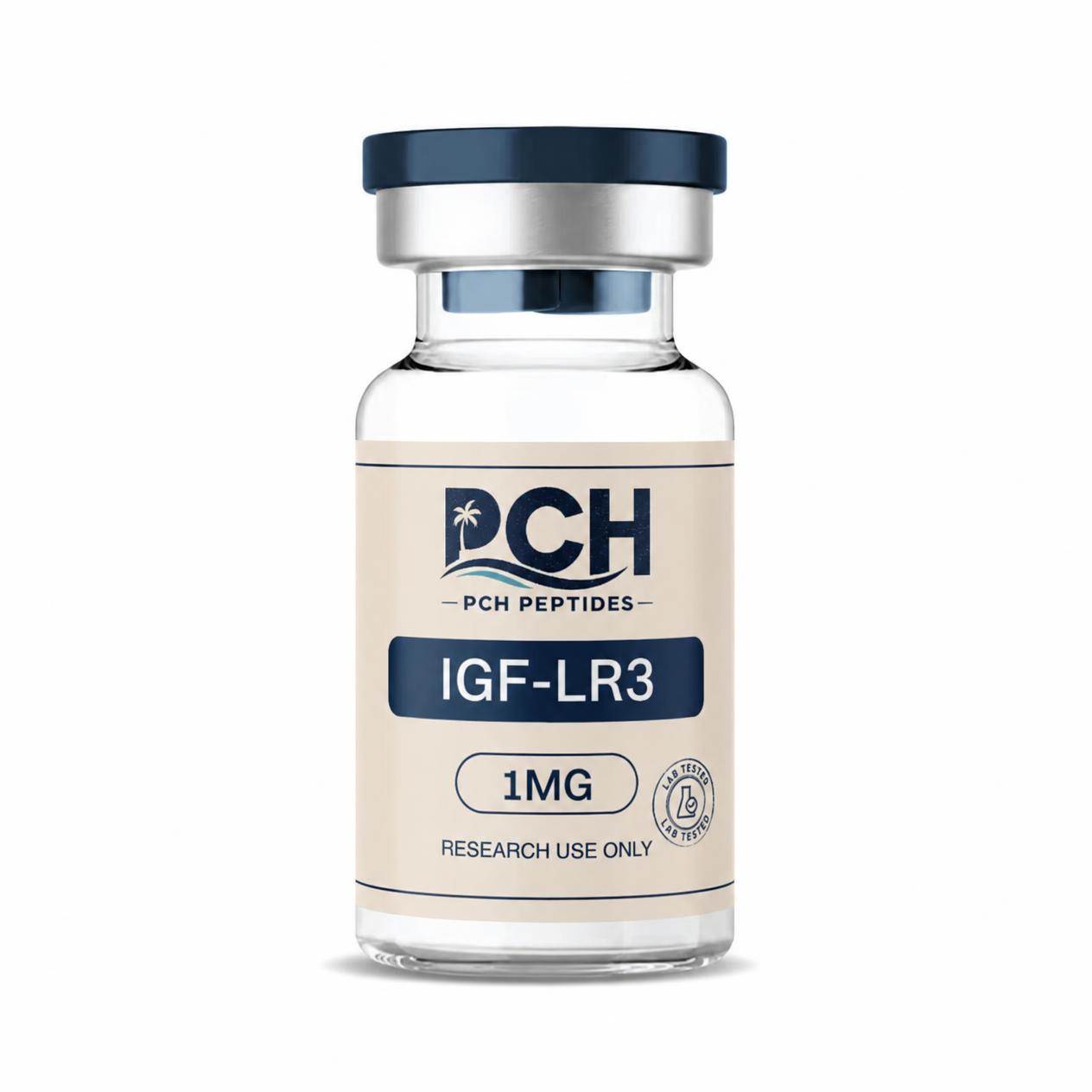
IGF-LR3 1mg Specifications
| Property | Value |
| Product name | IGF-LR3 |
| Also known as | IGF-1 LR3, Long R3 IGF-1, LR3-IGF-1 |
| Compound type | Synthetic IGF-1 analogue |
| Length | 83 amino acids |
| Parent compound | Human insulin-like growth factor 1 |
| Structural modifications | Glu3-to-Arg substitution and 13-residue N-terminal extension |
| Primary receptor studied | IGF-1 receptor (IGF-1R) |
| Molecular weight | Approximately 9111 Da |
| Amount per vial | 1mg |
| Form | Lyophilized protein analogue |
| Reported batch purity | 99.57% |
IGF-1 LR3 in Laboratory Research
IGF-1 LR3 is studied in biochemical and cellular research involving insulin-like growth factor signalling and the molecular characteristics of engineered growth-factor analogues.
IGF-1 Receptor Interaction
The insulin-like growth factor 1 receptor (IGF-1R) is a transmembrane receptor tyrosine kinase involved in cellular signalling.
Researchers investigate IGF-1 LR3 through receptor-binding assays and laboratory models designed to characterize ligand-receptor interactions.
Experimental studies may examine receptor activation, molecular affinity and downstream signalling responses under controlled conditions.
The analogue’s structural modifications make it useful for comparative investigations involving native IGF-1 and modified peptide growth factors.
IGF-Binding Protein Interactions
Insulin-like growth factor-binding proteins (IGFBPs) influence the distribution and availability of IGF-related molecules.
IGF-1 LR3 has reduced affinity for several IGF-binding proteins compared with native IGF-1.
This characteristic is associated with its modified amino acid sequence and N-terminal extension.
Researchers use controlled laboratory models to investigate how differences in binding-protein affinity influence molecular availability and receptor interactions.
These findings are relevant to biochemical characterization and comparative growth-factor research rather than establishing clinical effects.
Cellular Signalling Research
IGF-1-related signalling is studied in laboratory models involving receptor-mediated molecular pathways.
Researchers investigate the interactions of IGF-1 LR3 with signalling systems associated with the IGF-1 receptor, including pathways involving PI3K-AKT and MAPK proteins.
These experimental models are used to characterize receptor interactions, protein signalling and molecular responses.
Research findings from cell-culture or biochemical studies should not be interpreted as evidence of safety or therapeutic effectiveness in humans.
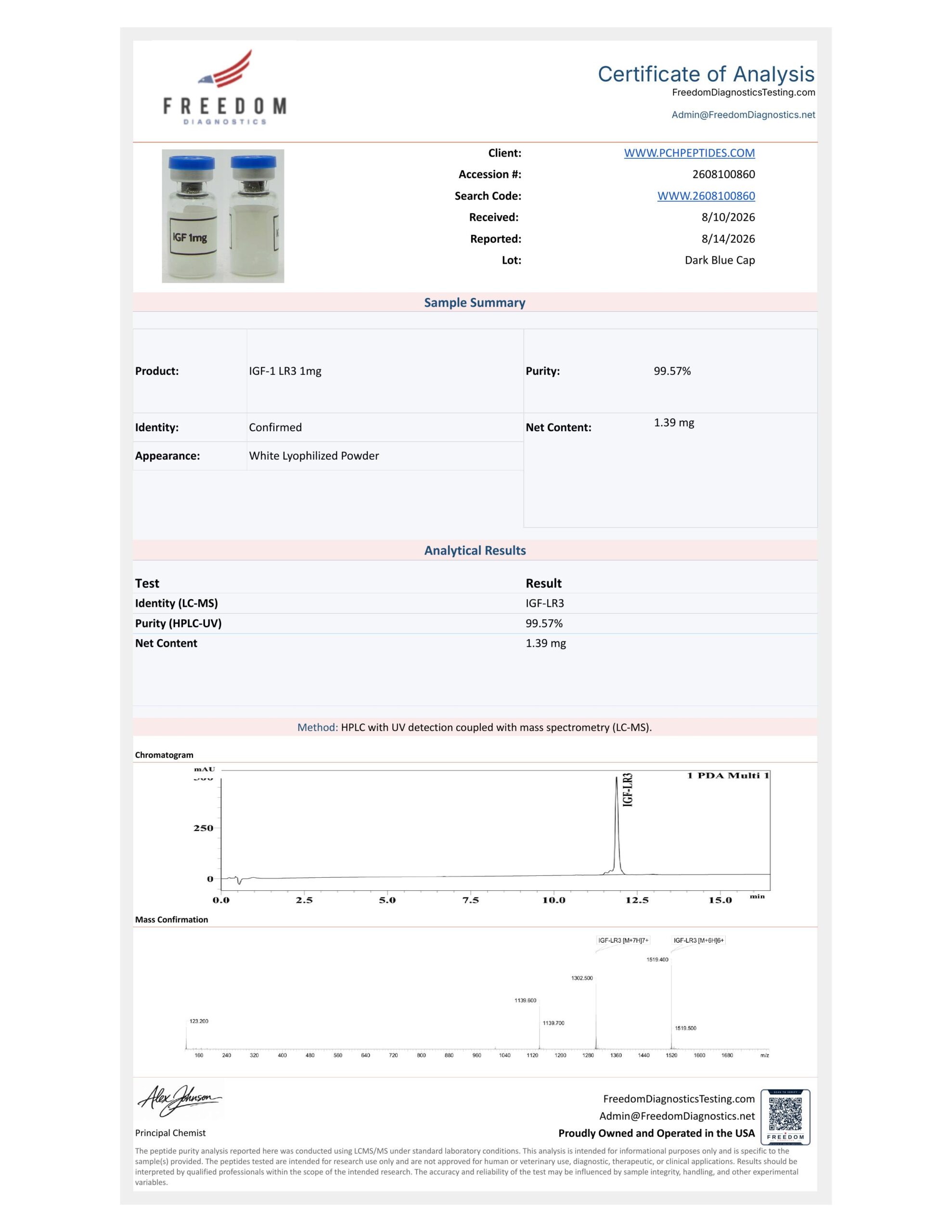
Certificate of Analysis
PCH Peptides provides batch-specific analytical documentation for its IGF-LR3 research material.
The PCH Peptides COA Library currently lists one Certificate of Analysis for IGF-LR3.
The submitted HPLC purity figure for the 1mg configuration is 99.57%.
Researchers should verify this percentage against the applicable batch Certificate of Analysis before relying on it as a current testing result.
The COA should be reviewed for material identity, analytical purity, batch identification and available testing findings.
Analytical documentation helps laboratories assess material quality and consistency for controlled research applications.
For additional information about research material classifications and analytical documentation, review the Research Use Only Peptides Guide.
Storage and Handling
Keep the IGF-LR3 vial sealed until required for an authorized laboratory workflow.
As an 83-amino-acid protein analogue, IGF-1 LR3 has structural characteristics that require careful consideration during laboratory storage and handling.
Protect the lyophilized material from moisture, excessive heat and direct light.
Store it according to the temperature recommendations printed on the product label and any applicable batch-specific documentation.
Appropriate handling conditions help preserve material integrity and reduce the risk of degradation during laboratory investigations.
Avoid using material from containers with damaged packaging, broken seals or uncertain identification.
Researchers should follow validated institutional laboratory procedures for the handling and characterization of protein-based research materials.
For general educational information about lyophilized peptides, read the guide on how peptide reconstitution works.
Related Research Materials
Laboratories investigating growth-factor signalling, growth hormone-related pathways and peptide receptor interactions may also examine other research compounds.
- CJC-1295 No DAC – A modified growth-hormone-releasing-hormone analogue investigated in GHRH receptor-binding assays, peptide stability studies and molecular signalling research.
- Ipamorelin – A synthetic pentapeptide studied for its interaction with the ghrelin receptor (GHS-R1a) and related peptide signalling pathways.
- Tesamorelin – A stabilized synthetic GHRH analogue investigated in controlled laboratory models involving receptor interactions and growth hormone-related signalling.
Although these compounds are associated with growth hormone-related research, they interact with different molecular targets.
IGF-1 LR3 is investigated primarily in relation to IGF-1 receptor signalling, while CJC-1295 No DAC and Tesamorelin are associated with GHRH receptor research.
Ipamorelin is studied in relation to the ghrelin receptor.
These distinctions make the compounds relevant to comparative investigations involving different peptide receptor systems.
Researchers can explore additional materials through the PCH Peptides research catalog.
Frequently Asked Questions
What does LR3 mean in IGF-1 LR3?
The name LR3 refers to two structural modifications made to native insulin-like growth factor 1.
“L” stands for Long, referring to the additional 13-amino-acid extension at the N-terminus.
“R3” indicates that arginine replaces glutamic acid at position 3 of the native IGF-1 sequence.
Together, these modifications produce an 83-amino-acid IGF-1 analogue.
How is IGF-1 LR3 different from IGF-1?
Native human IGF-1 contains 70 amino acids, while IGF-1 LR3 contains 83.
IGF-1 LR3 includes a 13-residue N-terminal extension and an arginine substitution at position 3.
These structural differences reduce its affinity for certain IGF-binding proteins compared with native IGF-1.
Researchers investigate these differences in laboratory models involving receptor interactions, molecular availability and protein signalling.
What is IGF-1 LR3 used for in research?
IGF-1 LR3 is investigated in biochemical and cellular research involving IGF-1 receptor binding, protein signalling, growth-factor interactions and peptide analogue characterization.
Researchers also study its reduced binding affinity for IGF-binding proteins and compare its molecular behaviour with native IGF-1.
These applications are limited to controlled laboratory research and do not establish therapeutic safety or effectiveness.
What purity is your IGF-1 LR3?
The submitted batch HPLC purity figure is 99.57%.
This percentage should be confirmed against the current 1mg batch Certificate of Analysis before being presented as a verified result.
Available documentation can be reviewed through the COA Library.
What is the molecular weight of IGF-1 LR3?
IGF-1 LR3 has an approximate molecular weight of 9111 Da, or 9.11 kDa.
Its molecular structure contains 83 amino acids, including the modified residue at position 3 and the 13-amino-acid N-terminal extension.
What size does IGF-LR3 come in?
PCH Peptides lists IGF-LR3 as a 1mg lyophilized research material in a single vial.
It is supplied for qualified laboratory, academic and institutional research applications.
Is IGF-LR3 batch tested?
The PCH Peptides COA Library lists one Certificate of Analysis for IGF-LR3.
Researchers should review the applicable batch report to confirm compound identity, purity and available analytical testing results.
The certificate can be accessed through the COA Library.
How should IGF-1 LR3 be stored?
IGF-1 LR3 should remain sealed and protected from moisture, excessive heat and direct light.
Follow the storage temperature and handling recommendations provided on the product label and applicable batch-specific documentation.
Appropriate storage is important for maintaining the integrity of protein analogue research materials.
Is IGF-1 LR3 the same as human growth hormone?
No. IGF-1 LR3 is a modified analogue of insulin-like growth factor 1, while human growth hormone is a different protein hormone.
These compounds have distinct molecular structures and receptor interactions.
IGF-1 LR3 is primarily associated with IGF-1 receptor research rather than direct growth hormone receptor binding.
Is IGF-LR3 intended for human or animal use?
No. IGF-LR3 is supplied strictly for laboratory, academic and institutional research.
It is not intended for human or animal consumption, injection, therapeutic applications, diagnosis or veterinary use.
For additional information about research material restrictions, review the Research Use Only Peptides Guide.
Do you provide dosage instructions for IGF-LR3?
No. PCH Peptides does not provide dosage, administration or usage protocols. IGF-LR3 is supplied exclusively for qualified research use only.