Research Use Only Disclaimer
SNAP-8 is sold strictly for laboratory, academic and institutional research. It is not for human or animal consumption, injection, or any therapeutic, diagnostic or veterinary use.
PCH Peptides does not provide dosage, administration or usage guidance. The product is intended exclusively for qualified researchers working in controlled laboratory environments.
What Is SNAP-8?
SNAP-8, also known as Acetyl Octapeptide-3, is a synthetic octapeptide consisting of eight amino acid residues.
Its amino acid sequence is Ac-Glu-Glu-Met-Gln-Arg-Arg-Ala-Asp-NH2.
The peptide contains an acetyl group at its N-terminus and an amide group at its C-terminus.
SNAP-8 was developed as an extended peptide analogue associated with Argireline, also known as Acetyl Hexapeptide-3.
Its structure is designed around a sequence related to the SNAP-25 protein, a component of the soluble N-ethylmaleimide-sensitive factor attachment protein receptor (SNARE) complex.
The SNARE complex is involved in membrane fusion processes, including the fusion of intracellular vesicles with target membranes.
Researchers investigate SNAP-8 in experimental models involving peptide-protein interactions, molecular characterization and potential interference with SNARE-complex assembly.
Its structural relationship with SNAP-25 makes it relevant to biochemical investigations involving protein-interaction mechanisms and peptide mimicry.
SNAP-8 is also discussed in cosmetic-science research, where synthetic peptides are examined for their molecular properties and interactions with skin-associated biological systems.
However, experimental findings should not be interpreted as evidence that research-grade SNAP-8 is safe or effective for cosmetic or therapeutic use.
For additional educational information about peptide structures and research applications, explore the What Are Peptides? Research Guide.
SNAP-8 10mg Specifications
| Property | Value |
| Product name | SNAP-8 |
| Also known as | Acetyl Octapeptide-3 |
| Peptide type | Synthetic octapeptide |
| Amino acid sequence | Ac-Glu-Glu-Met-Gln-Arg-Arg-Ala-Asp-NH2 |
| Single-letter sequence | Ac-EEMQRRAD-NH2 |
| Length | 8 amino acid residues |
| Structural modifications | N-terminal acetylation and C-terminal amidation |
| Molecular formula | C41H70N16O16S (confirm exact chemical reference form) |
| Molecular weight | Approximately 1075.2 g/mol (confirm against batch documentation) |
| Research association | SNAP-25 and SNARE-complex interactions |
| Amount per vial | 10mg |
| Form | Lyophilized powder |
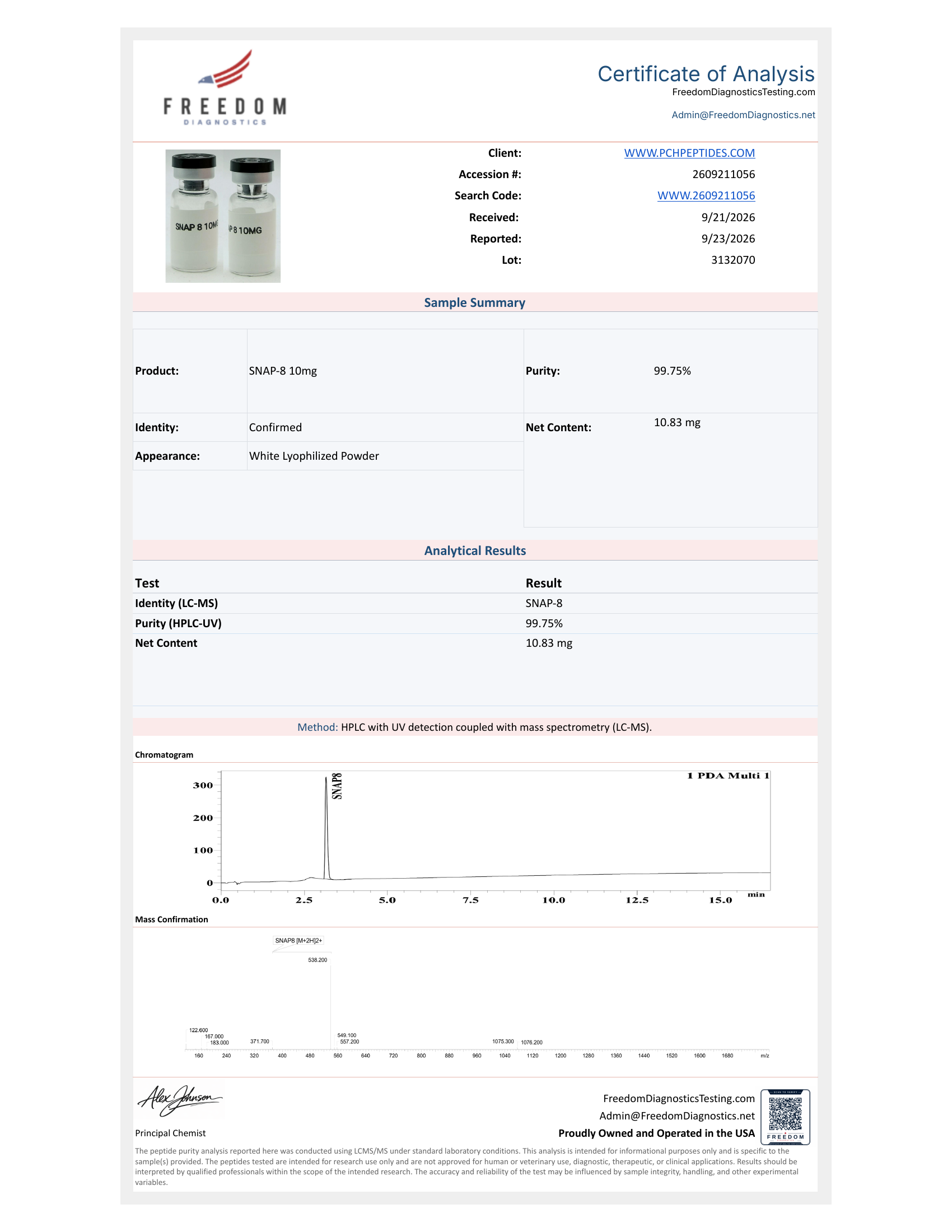
| Purity | 99.75% |
SNAP-8 in Laboratory Research
SNAP-8 is investigated in biochemical and molecular studies involving peptide mimicry, protein-protein interactions, SNARE-complex-associated mechanisms and synthetic peptide stability.
SNAP-25 Protein Interaction Research
SNAP-25, or Synaptosomal-Associated Protein 25, is a protein involved in the assembly and function of the SNARE complex.
It contributes to molecular interactions required for membrane fusion processes.
SNAP-8 contains a sequence designed to resemble a region associated with SNAP-25.
Researchers investigate SNAP-8 through biochemical and molecular models examining peptide-protein interactions and the properties of synthetic protein-fragment mimetics.
Experimental studies may examine how structural similarities influence molecular binding and protein-complex interactions.
These investigations help characterize peptide mimicry and related biochemical mechanisms.
SNARE-Complex Assembly Research
The SNARE complex is formed through interactions among proteins involved in intracellular membrane fusion.
SNAP-25 is one of the proteins associated with this molecular system.
SNAP-8 has been investigated as a synthetic peptide designed to interact with processes associated with SNARE-complex assembly.
Laboratory models may examine whether SNAP-8 influences specific protein interactions or molecular assembly mechanisms.
Such proposed competitive interactions require experimental validation and should not be assumed to occur under all research conditions.
The results contribute to understanding synthetic peptide interactions with protein complexes.
Peptide Mimicry and Molecular Characterization
Peptide mimicry involves designing short amino acid sequences that resemble regions of larger proteins.
SNAP-8 is an example of a synthetic peptide developed around a SNAP-25-associated sequence.
Researchers investigate how peptide length, amino acid arrangement and terminal modifications influence molecular behaviour.
SNAP-8’s N-terminal acetyl group and C-terminal amide are relevant to analytical studies examining synthetic peptide structure and chemical properties.
These modifications may influence peptide stability, conformation and interactions under experimental conditions.
Cosmetic-Science and Skin-Cell Research
SNAP-8 is also associated with research into synthetic peptides used in cosmetic-science formulations.
Researchers may examine its molecular properties, formulation stability and interactions with experimental biological systems.
Studies involving cosmetic peptides can include peptide stability, analytical characterization and compatibility with formulation ingredients.
However, results from biochemical or cell-based experiments do not establish the clinical effectiveness of research-grade SNAP-8 in topical products.
PCH Peptides supplies SNAP-8 strictly for laboratory research rather than direct cosmetic use.
Peptide Stability and Analytical Research
SNAP-8’s defined eight-amino-acid structure makes it relevant to analytical investigations involving peptide identification and stability.
Researchers may examine its chemical characteristics, degradation behaviour and structural integrity under controlled laboratory conditions.
Analytical techniques can be used to investigate peptide identity and purity, depending on the requirements of the research study.
These investigations contribute to understanding the properties of synthetic octapeptides and related protein-fragment mimetics.
Certificate of Analysis
PCH Peptides provides batch-specific analytical documentation for its SNAP-8 research material.
The PCH Peptides COA Library currently lists one Certificate of Analysis for SNAP-8.
Researchers should review the applicable batch certificate to confirm compound identity, HPLC purity and other available analytical findings.
The exact purity percentage should be taken directly from the current batch documentation rather than assumed from general product specifications.
The certificate should also be checked to confirm the molecular identity of the supplied material, including relevant terminal modifications and any formulation-specific specifications.
Batch-specific analytical documentation helps laboratories assess material consistency and traceability.
For additional information about research material classifications and testing documentation, review the Research Use Only Peptides Guide.
Storage and Handling
Keep the SNAP-8 vial sealed until required for an authorized laboratory workflow.
Store the lyophilized research material in a cold, dry environment protected from moisture, excessive heat and direct light.
Follow the storage temperature and handling recommendations provided on the product label and applicable batch-specific documentation.
Appropriate storage conditions help maintain the integrity of synthetic peptide research materials during laboratory handling.
Avoid using material from containers with damaged packaging, broken seals or uncertain identification.
Reconstitution Solution is available separately for suitable laboratory applications, subject to the compatibility requirements of the intended research workflow.
Researchers seeking general information about lyophilized peptide preparation can review the educational article on how peptide reconstitution works.
Related Research Materials
Laboratories investigating synthetic peptides, skin-cell-associated molecular processes and biochemical interactions may also examine other research compounds.
- GHK-Cu – A copper-binding tripeptide complex consisting of Gly-His-Lys coordinated with copper. Researchers investigate it in peptide-metal interactions, cellular signalling and extracellular matrix-associated molecular studies.
- GLOW Blend – A three-component research formulation containing GHK-Cu 50mg, BPC-157 10mg and TB-500 10mg. It is investigated in multi-component peptide characterization and comparative analytical research.
- KPV – A synthetic tripeptide derived from the C-terminal sequence of alpha-MSH, investigated in short-peptide chemistry and cellular signalling research.
These materials have different molecular structures and experimental research applications.
SNAP-8 is primarily associated with peptide mimicry and SNAP-25-related protein-interaction research, while GHK-Cu is a copper-binding peptide complex.
GLOW Blend contains multiple peptide components rather than a single defined octapeptide.
Researchers can explore additional compounds through the PCH Peptides research catalog.
Frequently Asked Questions
Is SNAP-8 the same as Acetyl Octapeptide-3?
Yes. SNAP-8 is a name commonly used for Acetyl Octapeptide-3, a synthetic eight-amino-acid peptide.
Its sequence is Ac-Glu-Glu-Met-Gln-Arg-Arg-Ala-Asp-NH2.
The peptide includes N-terminal acetylation and C-terminal amidation, which are important characteristics of its chemical structure.
What is the SNAP-8 amino acid sequence?
SNAP-8 contains eight amino acid residues arranged in the sequence Ac-Glu-Glu-Met-Gln-Arg-Arg-Ala-Asp-NH2.
Its single-letter representation is Ac-EEMQRRAD-NH2.
The sequence is associated with the SNAP-25 protein and is investigated in peptide mimicry and molecular interaction research.
How is SNAP-8 different from Argireline?
Argireline, commonly identified as Acetyl Hexapeptide-3, is a synthetic hexapeptide.
SNAP-8 is an octapeptide containing eight amino acid residues.
SNAP-8 extends the related peptide sequence by two amino acids, resulting in a different molecular structure.
Researchers compare the compounds in laboratory investigations involving peptide mimicry, structural characterization and protein interactions.
What is SNAP-8 used for in research?
SNAP-8 is investigated in laboratory studies involving SNAP-25-associated peptide mimicry, SNARE-complex-related protein interactions and molecular characterization.
Researchers also examine its chemical stability, peptide structure and properties in experimental formulation systems.
These applications do not establish cosmetic or therapeutic effectiveness in humans.
What is the SNARE complex?
The SNARE complex is a group of interacting proteins involved in membrane fusion processes.
Proteins such as SNAP-25 participate in the molecular machinery associated with vesicle fusion.
Researchers investigate SNARE-complex interactions to understand protein assembly, molecular signalling and membrane-associated biological processes.
SNAP-8 is studied as a synthetic peptide associated with SNAP-25-related protein-interaction research.
What is the molecular weight of SNAP-8?
A commonly cited molecular weight for acetylated and amidated SNAP-8 is approximately 1075.2 g/mol.
Published chemical databases and supplier references contain differing molecular specifications for SNAP-8. Researchers should confirm the exact molecular identity, formula and mass against the appropriate reference structure and batch Certificate of Analysis.
What size does SNAP-8 come in?
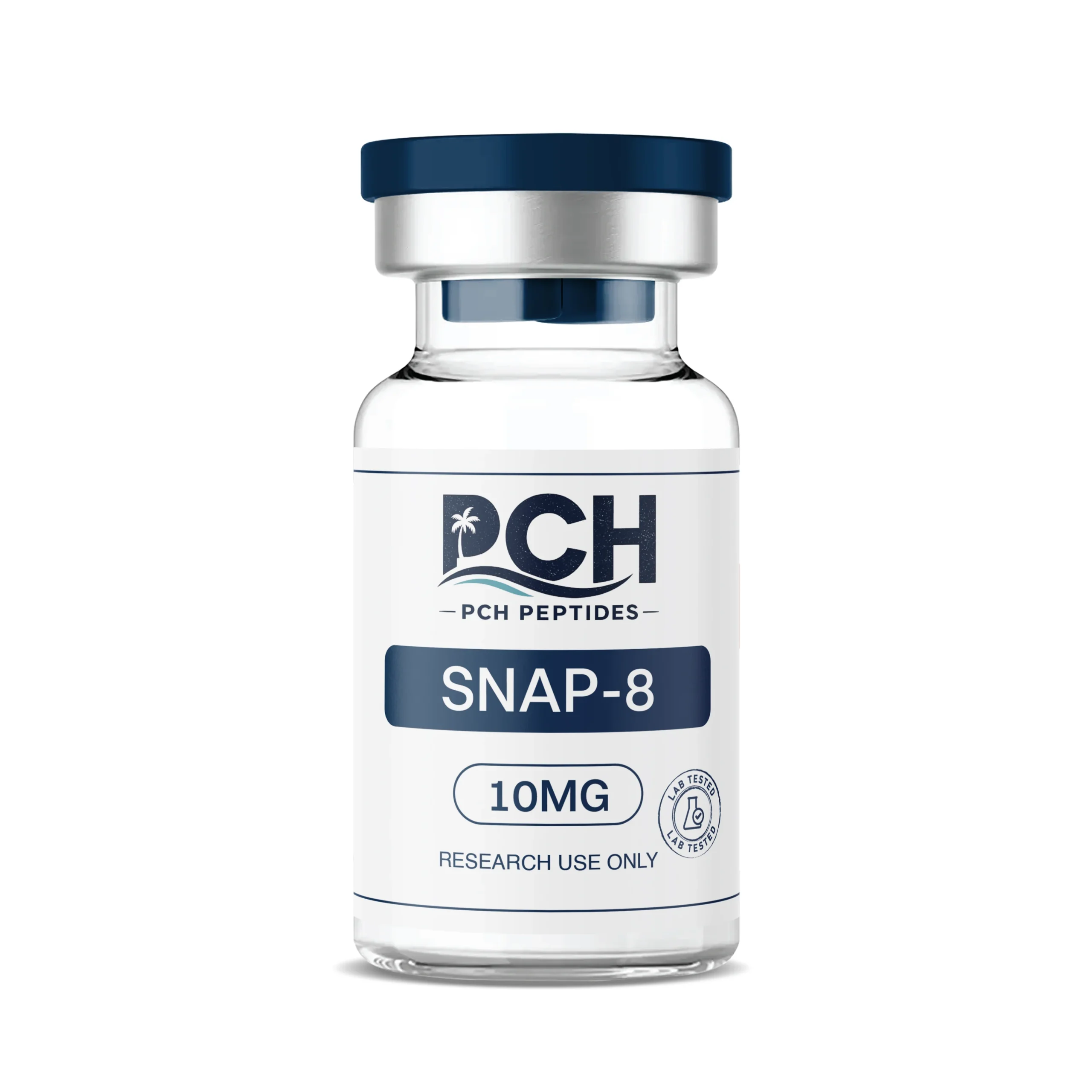
PCH Peptides supplies SNAP-8 as a 10mg lyophilized research material in a single vial.
The product is intended exclusively for qualified laboratory, academic and institutional research.
Is SNAP-8 batch tested?
The PCH Peptides COA Library lists one Certificate of Analysis for SNAP-8.
Researchers should review the applicable batch documentation to verify compound identity, purity and available analytical findings.
The documentation can be accessed through the COA Library.
How should SNAP-8 be stored?
SNAP-8 should remain sealed and protected from moisture, excessive heat and direct light.
Follow the storage temperature and handling recommendations provided on the product label and any applicable batch-specific documentation.
Appropriate storage helps maintain the integrity of lyophilized peptide research materials.
Is SNAP-8 intended for human, animal or cosmetic use?
No. PCH Peptides supplies SNAP-8 strictly for laboratory, academic and institutional research.
It is not intended for human or animal consumption, injection, cosmetic application, therapeutic use, diagnosis or veterinary applications.
For additional information about research material classifications, review the Research Use Only Peptides Guide.
Do you provide dosage instructions for SNAP-8?
No. PCH Peptides does not provide dosage, administration or usage protocols. SNAP-8 is supplied exclusively for qualified research use only.