
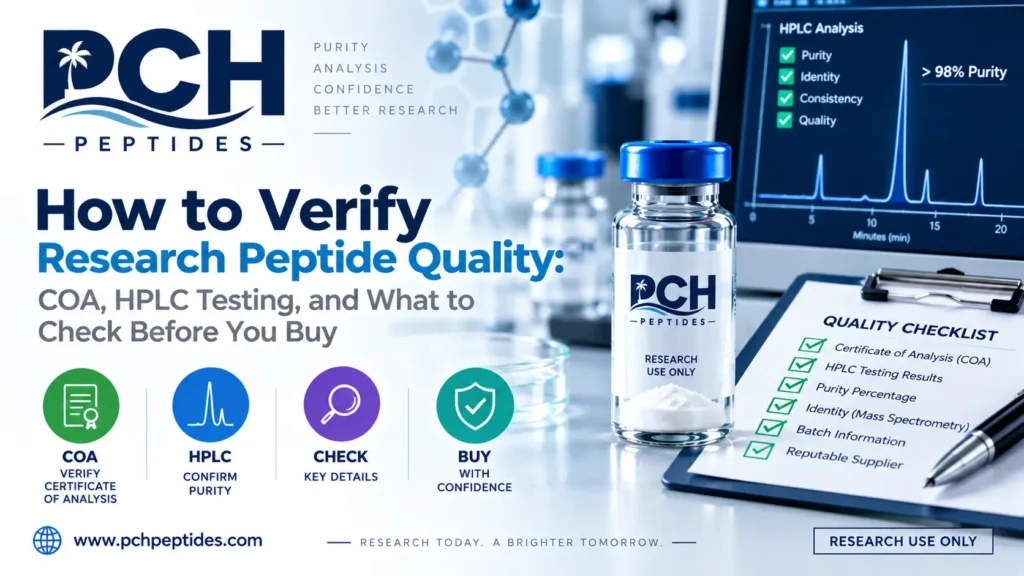
Given how many research peptide vendors have shut down or faced enforcement action over the past year, knowing how to verify peptide quality has become essential rather than optional. This guide walks through what a Certificate of Analysis actually shows, how HPLC testing works, and what researchers should check before trusting a supplier with their laboratory work.
What Are Peptides and Why Quality Verification Matters
Peptides are short chains of amino acids studied across a wide range of laboratory research applications, from cellular signaling to structural biology. Because these compounds are used in precise, controlled research settings, even small deviations in purity or identity can compromise an entire study.
This is exactly why peptide quality standards 2026 have shifted so dramatically. In an environment where fake peptides online have become a documented problem, and where entire vendors have disappeared following quality and regulatory failures, verification is no longer a nice-to-have step. It’s the foundation of trustworthy research.
How to Verify Peptide Quality
How to verify peptide quality comes down to checking a specific set of documentation and testing evidence before you rely on a compound in your research. This isn’t about trusting a vendor’s word, it’s about independently confirming that what’s in the vial matches what’s on the label.
Why Trusting a Product Listing Alone Isn’t Enough
A product description can claim any purity percentage a vendor wants to write. Without independent verification, there’s no way to know whether that number reflects reality. This gap between marketing claims and actual lab-tested results is precisely what allowed so many low-quality or mislabeled products to circulate before recent enforcement caught up with the vendors selling them.
The Core Verification Checklist
Before trusting any research peptide, check for the following:
- A batch-specific Certificate of Analysis, not a generic quality statement
- Confirmation that testing was performed by an independent, third-party lab
- HPLC or mass spectrometry data supporting the purity claim
- A batch or lot number that matches the specific product received
- Transparent company information, including a real business address and USA-based operations
How to Verify Peptide COA
How to verify peptide COA starts with understanding what a legitimate Certificate of Analysis actually contains, since not every document labeled “COA” meets the same standard.
What a Legitimate COA Should Include
A proper COA should show the compound’s identity confirmation, its measured purity percentage, the specific batch or lot number it applies to, and the testing method used to generate those results. Ideally, it should also name the independent lab that performed the analysis, rather than simply stating results without attribution.
How to Read Peptide COA Documents
How to read peptide COA reports becomes much easier once you know what to look for. Start with the batch number and confirm it matches the product you received. Next, check the purity percentage and compare it against what the product listing claims. Finally, look at the testing method listed, since this tells you how rigorously the compound was actually analyzed.
Red Flags in COA Documentation
A few warning signs suggest a COA may not be reliable:
- No batch number, making it impossible to confirm the document matches your specific order
- No named testing lab or method disclosed
- A COA that appears identical across multiple different product listings
- Formatting inconsistencies suggesting the document may have been altered
What Is HPLC Peptide Testing
What is HPLC peptide testing is one of the most common questions researchers ask when trying to understand purity documentation. HPLC stands for High-Performance Liquid Chromatography, a laboratory method used to separate, identify, and quantify compounds within a sample.
How HPLC Testing Works
In simple terms, HPLC testing pushes a sample through a specialized column under high pressure, separating its components based on how they interact with the column material. This separation allows analysts to identify the target compound and measure how much of the sample is actually made up of that compound, which is how purity percentages are calculated.
Why HPLC Is the Standard for Peptide Purity Verification
HPLC has become the standard method for peptide purity verification because it provides precise, reproducible results that can be independently confirmed. When a research peptide company references HPLC testing on its COA, it’s signaling that the purity claim isn’t just an estimate, it’s backed by an established analytical method.
Third Party Tested Peptides and Why Independence Matters
Third party tested peptides carry more credibility than products tested exclusively in-house, since an independent lab has no financial incentive to inflate purity results in a vendor’s favor.
In-House Testing vs Independent Verification
A vendor testing its own products internally isn’t necessarily dishonest, but it removes an important layer of accountability. Independent, third-party testing means a separate, unaffiliated lab is verifying the claims, which gives researchers a more objective basis for trust.
Why This Distinction Became Critical in 2026
Given the wave of vendor shutdowns and enforcement actions across the research peptide industry over the past year, independent verification has moved from a marketing differentiator to a baseline expectation. Several of the vendors that faced regulatory action or reputational collapse were found to have sold products that didn’t match their labeled purity or identity, underscoring exactly why this step can’t be skipped.
Avoiding Fake Peptides Online
Fake peptides online remain a real and documented risk, particularly as displaced demand from recent vendor shutdowns pushes researchers toward unfamiliar suppliers.
Common Warning Signs of a Low-Quality Vendor
- No COA available anywhere on the product page
- Prices significantly below the rest of the market with no explanation
- Vague or missing information about testing methodology
- No transparent company or contact information
- Marketing language that implies health, wellness, or performance outcomes
How PCH Peptides Approaches Documentation
PCH Peptides maintains batch-specific documentation across its entire catalog, viewable directly through the COA Library. This gives researchers a way to independently confirm identity and purity data before a compound is used in a study, rather than relying solely on product page claims.
Applying This to Your Own Sourcing Decisions
Once you understand how to verify peptide quality, applying that knowledge to an actual purchasing decision becomes much more straightforward.
A Practical Verification Process
Before ordering, pull up the vendor’s COA library or documentation page and confirm batch-specific records are actually available. Cross-check the testing method disclosed against the HPLC standard described earlier. Then verify the company’s transparency by checking for a real physical presence and USA-based shipping.
Where to Start
Researchers can review batch documentation for commonly studied compounds like BPC-157, TB-500, and GHK-Cu directly through the PCH Peptides COA Library, or browse the full research peptide catalog to compare available materials. For a broader understanding of how research use only classification relates to documentation standards, see our guide on RUO peptides.
Research Use Only Disclaimer
This article is provided for general educational purposes only. All products sold by PCH Peptides are supplied strictly for laboratory, academic, or institutional research purposes and are not intended for human or animal consumption, injection, or any therapeutic use. No dosage guidance, protocols, or claims of health, wellness, or performance outcomes are provided anywhere on this site.
Frequently Asked Questions
How do I verify peptide quality before buying?
Check for a batch-specific Certificate of Analysis, confirm independent third-party testing, and verify the testing method, ideally HPLC or mass spectrometry, before trusting a compound.
What is HPLC peptide testing?
HPLC, or High-Performance Liquid Chromatography, is a laboratory method used to separate and measure compounds within a sample, commonly used to verify peptide purity.
How do I read a peptide COA?
Check the batch number against your specific product, compare the purity percentage to the listed claim, and confirm the testing method and lab used to generate the results.
Why does third-party testing matter more than in-house testing?
An independent lab has no financial incentive to inflate results, giving researchers a more objective and trustworthy basis for verifying purity and identity claims.
How can I avoid fake peptides online?
Avoid vendors without visible COA documentation, unusually low prices, vague testing claims, or any health and wellness marketing language, since these are common warning signs.
Does PCH Peptides provide batch-specific testing documentation?
Yes. PCH Peptides maintains batch-specific COAs across its full catalog, available through the COA Library for independent verification.