Choosing a research peptide supplier has become a more consequential decision than it used to be. With a wave of vendor shutdowns and enforcement actions reshaping the industry over the past year, researchers can no longer rely on price and product range alone when deciding where to source materials. This guide breaks down exactly what to evaluate before trusting a supplier with your laboratory work.
Why Supplier Evaluation Matters More Than Ever
Choosing a research peptide supplier used to come down to a fairly simple comparison of catalog size and pricing. That approach no longer holds up in the current environment.
The Shift Toward Compliance-First Evaluation
Recent closures across the research peptide market have shown that a large catalog and aggressive pricing can mask serious underlying problems, including missing documentation, unverified purity claims, and regulatory noncompliance. A reliable peptide supplier USA researchers can actually depend on now needs to demonstrate transparency and documentation, not just competitive pricing.
What’s at Stake When You Choose Poorly
Sourcing from an unreliable vendor puts more than a single order at risk. It can compromise the accuracy of an entire research project if a compound’s actual purity or identity doesn’t match what was ordered, and it can expose a lab or institution to unnecessary risk if a supplier is later flagged for regulatory violations.
How to Choose a Peptide Supplier
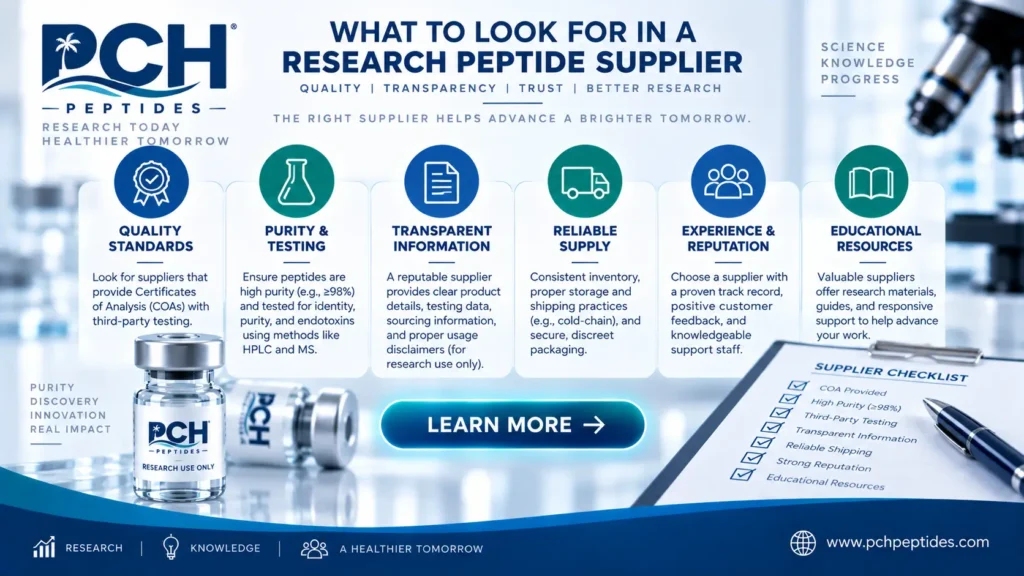
How to choose a peptide supplier comes down to evaluating a consistent set of criteria, rather than relying on marketing claims or price alone.
Clear Research Use Only Labeling
Every product listing should be clearly and consistently labeled as intended strictly for laboratory, academic, or institutional research. A trustworthy research peptide company checklist should always start here, since suppliers who blur this line with implied human use or vague labeling are operating outside the boundaries that keep RUO sales legal in the first place.
Documented Batch-Specific Testing
Independent, batch-specific Certificates of Analysis are one of the clearest signals of a compliant supplier. A COA should confirm the compound’s identity, its purity percentage, and the specific batch it applies to, ideally backed by HPLC or mass spectrometry testing performed by an independent lab. PCH Peptides maintains this kind of documentation across its full catalog, viewable through the COA Library.
Transparent Company Information
A legitimate research peptide supplier should be easy to identify and contact. Real business information, a physical presence, and responsive customer support are all signs of a company operating openly rather than trying to remain anonymous.
No Health, Wellness, or Performance Claims
Compliant suppliers do not market research peptides with language implying health benefits, performance outcomes, or therapeutic use. Any vendor making these kinds of claims has moved outside the boundaries of legitimate research use only sales, and that same pattern has been directly tied to several of the enforcement actions and shutdowns seen across the industry recently.
Red Flags to Watch For in a Peptide Vendor
Understanding what a peptide supplier’s red flags list actually looks like in practice makes it much easier to filter out unreliable options before placing an order.
Missing or Vague Documentation
If a supplier can’t produce a batch-specific COA, or only offers a generic quality statement without testing details, that’s a significant warning sign. Documentation should be specific, verifiable, and tied to the actual product being purchased.
Prices That Seem Too Good to Be True
Unusually low prices compared to the rest of the market, with no clear explanation, often indicate cut corners somewhere in the supply chain, whether that’s testing, sourcing, or manufacturing standards.
Anonymous or Unreachable Companies
A supplier that hides its physical location, provides only a generic contact form, or is difficult to reach with product questions should raise concern. Transparency and accessibility are basic expectations for a legitimate research materials vendor.
Marketing Language That Crosses Into Health Claims
Any product page suggesting a compound will improve performance, treat a condition, or produce a specific physical outcome has crossed out of research use only territory. This kind of language is one of the clearest indicators of a supplier operating outside compliance boundaries.
Peptide Supplier Reviews and Verification
Peptide supplier reviews can offer useful context, but they shouldn’t replace your own direct verification of a vendor’s documentation and practices.
Why Reviews Alone Aren’t Enough
Online reviews can be manipulated, outdated, or simply unrepresentative of a supplier’s current practices, especially in an industry that has changed as rapidly as this one has over the past year. A supplier with positive reviews from a year ago may not reflect its current testing standards or regulatory standing today.
Verifying Documentation Yourself
The most reliable way to evaluate a research peptide company is to check its documentation directly. Look for a dedicated COA library or testing page, confirm that documents are batch-specific rather than generic, and cross-check the testing method disclosed against recognized laboratory standards like HPLC.
What a Trusted Peptide Supplier in 2026 Looks Like
A trusted peptide supplier 2026 profile looks different from what it might have looked like even two years ago, largely because the regulatory and reputational stakes have increased significantly across the industry.
USA-Based Operations and Shipping
Domestic sourcing generally supports more predictable shipping timelines and easier accountability compared to overseas suppliers, particularly in an environment where traceability has become increasingly important.
Consistency and Track Record
A supplier with a consistent operating history, rather than one that appeared suddenly during the recent wave of vendor turnover, offers more assurance of long-term reliability. PCH Peptides operates as a USA-based research peptide supplier built around these documentation and compliance standards from the outset.
Applying This Checklist to Your Own Sourcing
Once you understand what to look for, evaluating any individual supplier becomes a much more straightforward process.
A Quick Reference Checklist
Before placing an order with any research peptide supplier, confirm the following:
- Clear RUO labeling with no dosing or usage instructions
- Batch-specific COAs backed by independent testing
- Transparent company and contact information
- No health, wellness, or performance claims anywhere on the site
- USA-based shipping and consistent operating history
Where to Start Your Research
Researchers can review PCH Peptides’ full catalog of research materials, including commonly studied compounds like BPC-157, TB-500, and CJC-1295 No DAC, each backed by documentation available in the COA Library. For a broader understanding of how research use only classification applies to supplier evaluation, see our guide on RUO peptides, or browse our list of commonly studied research peptides. Questions about a specific compound or batch can be directed through the contact page.
Research Use Only Disclaimer
This article is provided for general educational purposes only. All products sold by PCH Peptides are supplied strictly for laboratory, academic, or institutional research purposes and are not intended for human or animal consumption, injection, or any therapeutic use. No dosage guidance, protocols, or claims of health, wellness, or performance outcomes are provided anywhere on this site.
Frequently Asked Questions
What should I look for in a research peptide supplier?
Look for clear RUO labeling, independent batch-specific testing documentation, transparent company information, and no health or performance claims anywhere on the site.
How do I verify a peptide supplier’s documentation?
Check for a dedicated COA library with batch-specific records, confirm the testing method used, and cross-check the batch number against the product you actually received.
Are online reviews enough to evaluate a peptide supplier?
No. Reviews can be outdated or manipulated. Direct verification of a supplier’s documentation is a more reliable evaluation method.
What are common red flags when choosing a peptide vendor?
Missing COA documentation, unusually low prices, anonymous company information, and marketing language implying health or performance outcomes are all significant warning signs.
Why does USA-based sourcing matter for research peptides?
Domestic sourcing generally supports more predictable shipping and easier accountability, which has become especially important given recent industry instability.
Does PCH Peptides provide batch-specific testing documentation?
Yes. PCH Peptides maintains batch-specific COAs across its full catalog, available through the COA Library for independent verification.