Research Use Only Disclaimer
SS-31 is sold strictly for laboratory, academic and institutional research. It is not intended for human or animal consumption, injection, or any therapeutic, diagnostic or veterinary use.
PCH Peptides does not provide dosage, administration or usage guidance. The product is intended exclusively for qualified researchers working in controlled laboratory environments.
Elamipretide is also the active ingredient in an FDA-approved prescription medication. The research-grade material listed here must not be represented as an approved pharmaceutical product. Research-use-only labeling does not independently establish regulatory authorization for its sale or distribution.
What Is SS-31?
SS-31, also known as Elamipretide, Bendavia and MTP-131, is a synthetic tetrapeptide belonging to the Szeto-Schiller family of mitochondrial-targeted peptides.
Its amino acid sequence is D-Arg-Dmt-Lys-Phe-NH2, where Dmt represents 2′,6′-dimethyltyrosine, a modified aromatic amino acid.
SS-31 contains alternating aromatic and positively charged residues, giving it structural characteristics associated with interactions involving mitochondrial membranes.
Researchers investigate SS-31 for its affinity for cardiolipin, a phospholipid concentrated in the inner mitochondrial membrane.
Cardiolipin is involved in mitochondrial membrane organization and interactions with proteins associated with cellular energy metabolism.
The interaction between SS-31 and cardiolipin makes the peptide relevant to laboratory models examining mitochondrial membrane chemistry, phospholipid-peptide interactions and molecular stability.
Researchers also examine its interactions with mitochondrial proteins and membrane-associated processes through biochemical and cellular experiments.
Unlike mitochondrial-derived peptides such as MOTS-C, SS-31 is a synthetic peptide designed to interact with mitochondrial structures.
For additional background on peptide structures and classifications, explore the What Are Peptides? Research Guide.
SS-31 10mg Specifications
| Property | Value |
| Product name | SS-31 |
| Also known as | Elamipretide, Bendavia, MTP-131 |
| Peptide type | Synthetic mitochondrial-targeted tetrapeptide |
| Peptide family | Szeto-Schiller peptides |
| Amino acid sequence | D-Arg-Dmt-Lys-Phe-NH2 |
| Length | 4 amino acid residues |
| Modified amino acid | Dmt (2′,6′-dimethyltyrosine) |
| Molecular formula | C32H49N9O5 |
| Molecular weight | Approximately 639.8 g/mol |
| Primary molecular interaction | Cardiolipin-associated membrane interactions |
| Research target | Inner mitochondrial membrane |
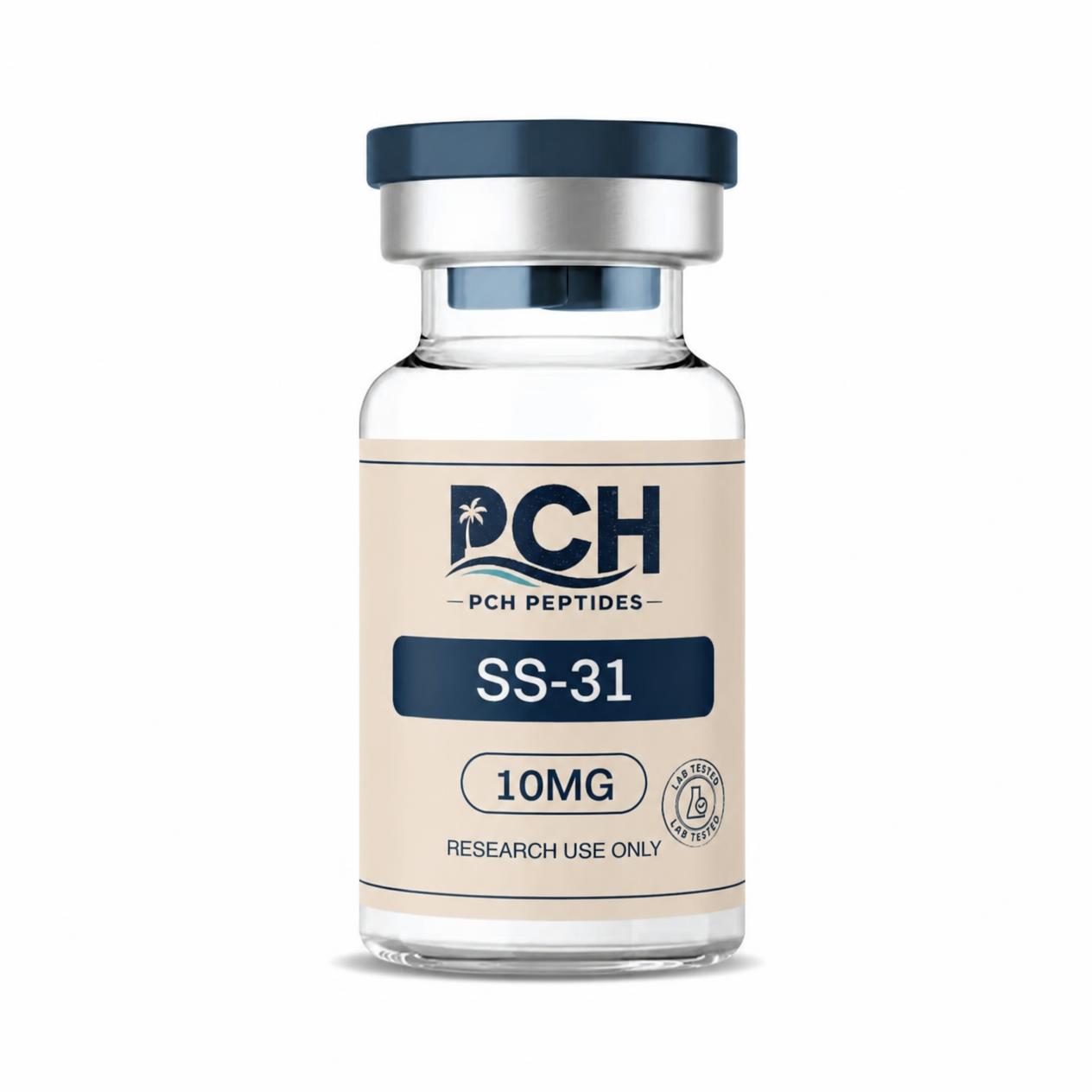
| Amount per vial | 10mg |
| Form | Lyophilized powder |
| Purity | 99.82% |
SS-31 in Laboratory Research
SS-31 is investigated in biochemical and cellular studies involving mitochondrial membrane chemistry, phospholipid interactions, peptide stability and mitochondrial-associated signalling mechanisms.
Cardiolipin-Binding Research
Cardiolipin is a phospholipid found predominantly in the inner mitochondrial membrane.
It contributes to membrane organization and interacts with several proteins associated with mitochondrial function.
SS-31 is investigated for its ability to interact with cardiolipin through molecular interactions influenced by its peptide structure.
Researchers examine these interactions using biochemical assays, membrane models and analytical techniques.
Experimental studies may investigate peptide-phospholipid association, membrane organization and changes in molecular interactions under controlled conditions.
These investigations contribute to the characterization of cardiolipin-binding peptides and mitochondrial membrane chemistry.
Inner Mitochondrial Membrane Research
The inner mitochondrial membrane contains protein complexes involved in oxidative phosphorylation and cellular energy metabolism.
Its structure and phospholipid composition are important areas of biochemical research.
SS-31 is investigated in models examining peptide interactions with mitochondrial membrane components.
Researchers may study its association with cardiolipin-containing membranes and its influence on measurable membrane-related properties.
These investigations help characterize how synthetic peptides interact with specialized biological membranes.
Electron Transport Chain Research
The mitochondrial electron transport chain consists of protein complexes involved in electron transfer and the generation of an electrochemical gradient.
Cardiolipin contributes to the structural environment of several mitochondrial protein complexes.
Researchers investigate SS-31 in experimental systems involving mitochondrial proteins, membrane-associated molecular interactions and oxidative phosphorylation-related processes.
Some preclinical investigations have examined changes in mitochondrial functional markers under controlled experimental conditions.
These findings remain dependent on the experimental model and do not establish the effects of research-grade SS-31 in humans.
Mitochondrial Membrane Stability Studies
SS-31 is relevant to laboratory investigations examining the physical and chemical characteristics of mitochondrial membranes.
Researchers may investigate peptide interactions with cardiolipin-containing lipid systems, membrane organization and molecular stability.
Such studies contribute to understanding how short synthetic peptides interact with phospholipid environments.
The results of laboratory experiments should not be interpreted as evidence of clinical safety or therapeutic effectiveness for research-grade products.
Synthetic Tetrapeptide Characterization
SS-31 contains four amino acid residues, including D-arginine and the modified aromatic residue Dmt.
These structural features distinguish it from conventional peptides composed exclusively of naturally occurring L-amino acids.
Researchers investigate SS-31 through peptide identification, chemical characterization, purity analysis and molecular stability studies.
Its defined sequence also makes it relevant to comparative investigations involving other mitochondrial-associated research peptides.
Certificate of Analysis
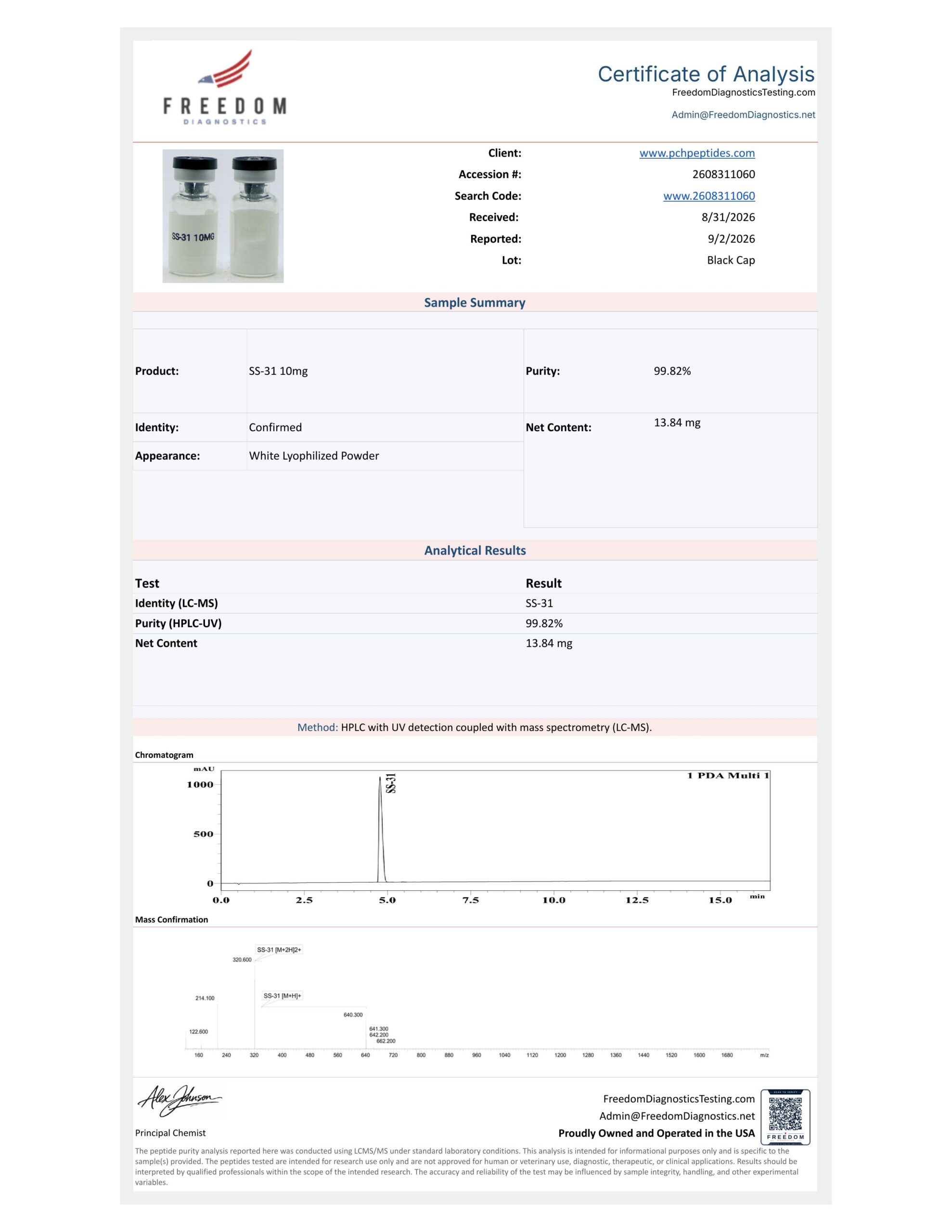
PCH Peptides provides batch-specific analytical documentation for its SS-31 research material.
The PCH Peptides COA Library currently lists one Certificate of Analysis and one endotoxin report for SS-31.
Researchers should review the applicable batch Certificate of Analysis to confirm compound identity, HPLC purity and other available analytical findings.
The exact purity percentage should be obtained directly from the current batch documentation rather than assumed from general product specifications.
The certificate should also be checked for any relevant salt-form or counterion specifications associated with the supplied material.
The endotoxin report should be reviewed separately because endotoxin testing and HPLC purity testing measure different aspects of material quality.
Batch-specific documentation supports laboratory quality assessment, analytical verification and material traceability.
For additional information about research material classifications and analytical documentation, review the Research Use Only Peptides Guide.
Storage and Handling
Keep the SS-31 vial sealed until required for an authorized laboratory workflow.
Store the lyophilized material in a cold, dry environment protected from moisture, excessive heat and direct light.
Follow the storage temperature and handling recommendations printed on the product label and applicable batch-specific documentation.
Appropriate storage conditions help maintain the integrity of synthetic peptides during laboratory handling and analytical investigation.
Avoid using material from containers with damaged packaging, broken seals or uncertain identification.
Reconstitution Solution is available separately for suitable laboratory applications, subject to compatibility with the intended research workflow.
Researchers seeking general information about lyophilized peptide handling can review the educational article on how peptide reconstitution works.
Related Research Materials
Laboratories investigating mitochondrial chemistry, cellular energy metabolism and peptide-associated molecular interactions may also examine other research compounds.
- MOTS-C – A mitochondrial-derived peptide encoded by mitochondrial DNA. Researchers investigate MOTS-C in cellular energy metabolism, metabolic signalling and mitochondrial-associated molecular research.
- NAD+ – Nicotinamide adenine dinucleotide is a naturally occurring redox-active coenzyme investigated in electron-transfer reactions, cellular energy metabolism and enzyme function.
- Glutathione – A naturally occurring tripeptide involved in cellular redox chemistry and investigated in oxidative-stress models and glutathione-dependent enzyme research.
Although these compounds are studied in overlapping areas of mitochondrial and cellular research, they have different molecular structures and biochemical roles.
SS-31 is a synthetic cardiolipin-interacting peptide, while MOTS-C is encoded by mitochondrial genetic material.
NAD+ functions as a redox-active coenzyme, whereas Glutathione participates in thiol-dependent biochemical reactions.
These differences make the materials relevant to comparative biochemical investigations.
Researchers can explore additional compounds through the PCH Peptides research catalog.
Frequently Asked Questions
Is SS-31 the same as Elamipretide?
Yes. SS-31 is a research designation for Elamipretide, a synthetic tetrapeptide also known as Bendavia and MTP-131.
Elamipretide is investigated for its interactions with cardiolipin and mitochondrial membrane structures.
Elamipretide is also the active ingredient in the FDA-approved prescription medication Forzinity. However, the PCH Peptides research-grade product is not equivalent to the approved pharmaceutical formulation.
What does SS-31 target?
SS-31 interacts with cardiolipin, a phospholipid concentrated in the inner mitochondrial membrane.
Researchers investigate this interaction through biochemical assays and membrane models involving peptide-phospholipid association and mitochondrial membrane chemistry.
What is SS-31 used for in research?
SS-31 is investigated in laboratory studies involving mitochondrial membrane chemistry, cardiolipin interactions, peptide stability and mitochondrial-associated molecular processes.
Researchers also examine its interactions with membrane-associated proteins and experimental models involving mitochondrial function.
These applications do not establish the safety or effectiveness of research-grade SS-31 for human use.
What is the amino acid sequence of SS-31?
SS-31 consists of four amino acid residues arranged in the sequence D-Arg-Dmt-Lys-Phe-NH2.
Dmt represents 2′,6′-dimethyltyrosine, a modified aromatic amino acid.
This sequence is associated with the peptide’s molecular characteristics and interactions with cardiolipin-containing membranes.
What is the molecular weight of SS-31?
The reference SS-31 peptide has an approximate molecular weight of 639.8 g/mol and a molecular formula of C32H49N9O5.
These specifications describe the peptide itself. Any salt-form or counterion differences should be confirmed against the applicable batch documentation.
How is SS-31 different from MOTS-C?
SS-31 is a synthetic tetrapeptide designed to interact with mitochondrial membrane components, particularly cardiolipin.
MOTS-C is a mitochondrial-derived peptide encoded by mitochondrial DNA.
Researchers investigate SS-31 primarily in mitochondrial membrane and phospholipid interaction models, while MOTS-C is studied in metabolic signalling and cellular energy-related research.
Is SS-31 a mitochondrial-derived peptide?
No. SS-31 is a synthetic peptide designed to interact with mitochondrial structures.
It is not encoded by mitochondrial DNA.
This distinguishes SS-31 from mitochondrial-derived peptides such as MOTS-C.
What size does SS-31 come in?
PCH Peptides supplies SS-31 as a 10mg lyophilized research material in a single vial.
The product is intended exclusively for qualified laboratory, academic and institutional research applications.
Is SS-31 batch tested?
The PCH Peptides COA Library lists one Certificate of Analysis and one endotoxin report for SS-31.
Researchers should review the applicable batch documentation to verify compound identity, purity and available analytical testing results.
Available documentation can be accessed through the COA Library.
How should SS-31 be stored?
SS-31 should remain sealed and protected from moisture, excessive heat and direct light.
Follow the storage temperature and handling recommendations provided on the product label and any applicable batch-specific documentation.
Appropriate storage helps maintain the integrity of lyophilized research materials.
Is SS-31 intended for human or animal use?
No. PCH Peptides lists this SS-31 product strictly for laboratory, academic and institutional research.
It is not intended for human or animal consumption, injection, diagnosis, treatment or veterinary use.
Although Elamipretide is an FDA-approved prescription drug ingredient, the research-grade SS-31 product is not an approved medication.
For additional information about research material classifications, review the Research Use Only Peptides Guide.
Do you provide dosage instructions for SS-31?
No. PCH Peptides does not provide dosage, administration or usage protocols. SS-31 is supplied exclusively for qualified research use only.