Research Use Only Disclaimer
KLOW Blend is sold strictly for laboratory, academic and institutional research. It is not for human or animal consumption, injection, or any therapeutic, diagnostic or veterinary use. PCH Peptides does not provide dosage, administration or usage guidance.
What Is KLOW Blend?
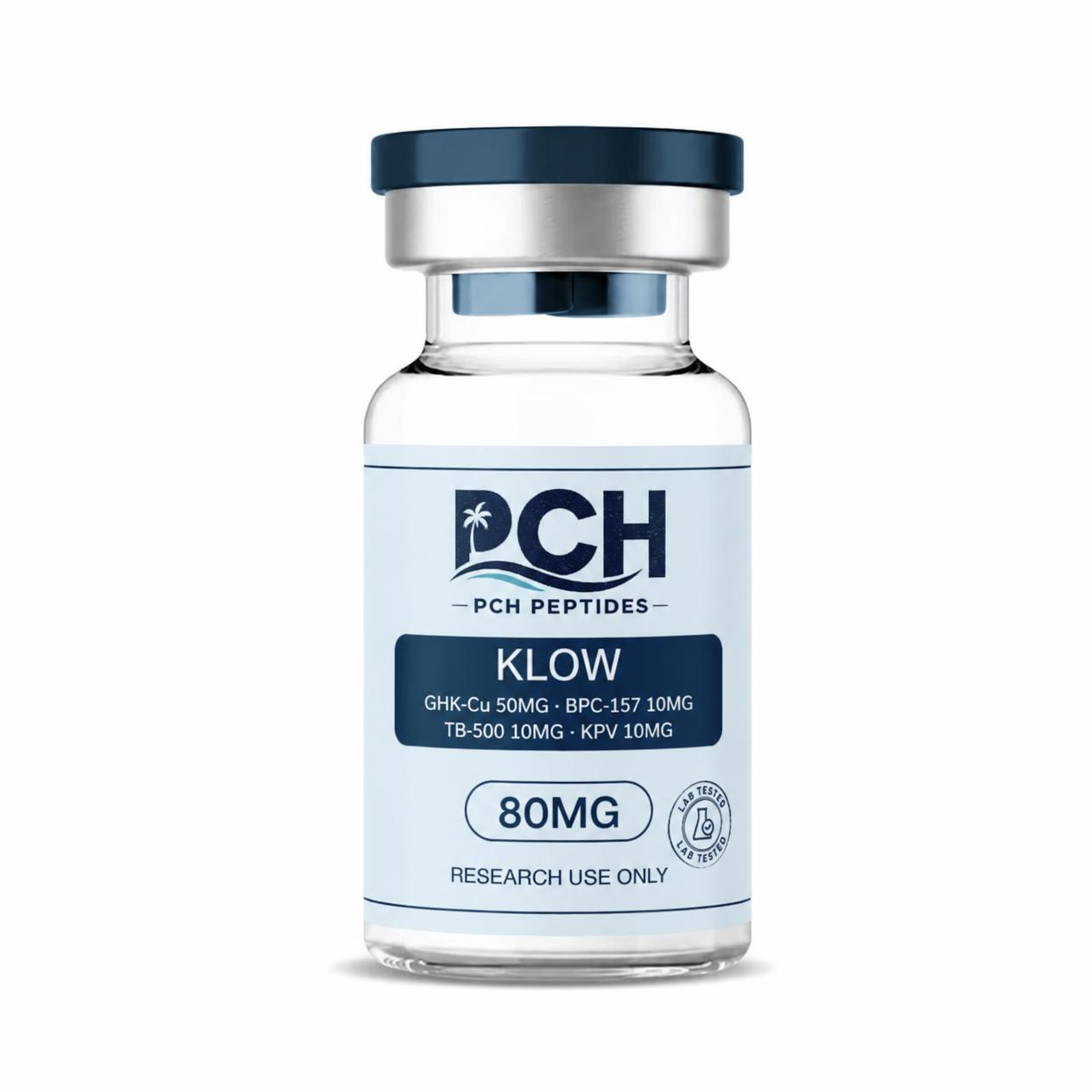
KLOW Blend is a four-component research peptide formulation combining GHK-Cu, BPC-157, TB-500 and KPV in a predefined mixture.
The formulation contains the same three components found in GLOW Blend, with the addition of KPV, a synthetic tripeptide derived from the C-terminal sequence of alpha-melanocyte-stimulating hormone (alpha-MSH).
Each component has distinct molecular characteristics and is investigated in different areas of non-clinical laboratory research.
GHK-Cu is a copper-binding peptide complex studied in peptide-metal coordination and cellular signalling models. BPC-157 is a synthetic pentadecapeptide examined in cellular and tissue-associated molecular research.
TB-500 is associated with thymosin beta-4-related peptide research, including cellular structure and migration models. KPV is investigated in laboratory studies involving short-peptide chemistry and inflammatory signalling pathways.
By combining these compounds in a fixed formulation, KLOW Blend provides laboratories with a consistent nominal component ratio for comparative analytical studies.
Each vial contains 50mg GHK-Cu, 10mg BPC-157, 10mg TB-500 and 10mg KPV, providing 80mg of total lyophilized research material.
Researchers investigating similar compounds can explore the list of research peptides for further information about peptide classifications and laboratory applications.
KLOW Blend 80mg Specifications
| Component | Amount | Type |
| GHK-Cu | 50mg | Copper-bound tripeptide complex (Gly-His-Lys) |
| BPC-157 | 10mg | Synthetic 15-amino-acid peptide |
| TB-500 | 10mg | Thymosin beta-4-related research peptide |
| KPV | 10mg | Synthetic tripeptide (Lys-Pro-Val) |
| Total per vial | 80mg | Four-component peptide formulation |
| Blend ratio | 5:1:1:1 | By weight |
| Form | — | Lyophilized powder |
| Reported batch purity | 99.69% | HPLC |
KLOW Blend Components and Laboratory Research
KLOW Blend contains four peptide-related compounds with different molecular structures and laboratory research applications.
GHK-Cu – Copper-Binding Tripeptide
GHK-Cu is a copper-binding peptide complex formed by the tripeptide Gly-His-Lys and a copper ion.
Researchers investigate GHK-Cu in laboratory studies involving metal-peptide coordination, extracellular matrix-associated processes and cellular signalling.
Its molecular structure makes it relevant to studies of copper-binding peptides and their interactions with biological molecules.
Researchers requiring independent analytical evaluation can review the GHK-Cu research peptide product page.
BPC-157 – Synthetic Pentadecapeptide
BPC-157 is a synthetic peptide consisting of 15 amino acid residues.
It is investigated in non-clinical research models involving molecular interactions, cellular signalling and tissue-associated biological processes.
Researchers also study its chemical properties, stability and interactions with experimental cellular systems.
The individual compound is available as BPC-157 for controlled laboratory investigations.
TB-500 – Thymosin Beta-4-Related Peptide
TB-500 is a synthetic research peptide associated with thymosin beta-4 sequence research.
Laboratory investigations examine thymosin beta-4-related peptides in models involving molecular characterization, cellular structure and cell-migration-related signalling.
The specific molecular identity of a TB-500 preparation should be verified against its batch documentation because the designation may be used for different thymosin beta-4-related materials.
Researchers can review the individual TB-500 research peptide product page for additional information.
KPV – Synthetic Regulatory Tripeptide
KPV is a synthetic tripeptide with the amino acid sequence Lys-Pro-Val.
It represents the C-terminal three-amino-acid sequence associated with alpha-melanocyte-stimulating hormone (alpha-MSH).
KPV is investigated in laboratory studies involving short-peptide chemistry, molecular stability and inflammatory signalling pathways.
Its compact molecular structure makes it relevant to research involving peptide-fragment characterization and cellular signalling interactions.
Researchers seeking the standalone compound can review the KPV research peptide product page.
Certificate of Analysis
PCH Peptides provides batch-specific analytical documentation for its research peptide formulations.
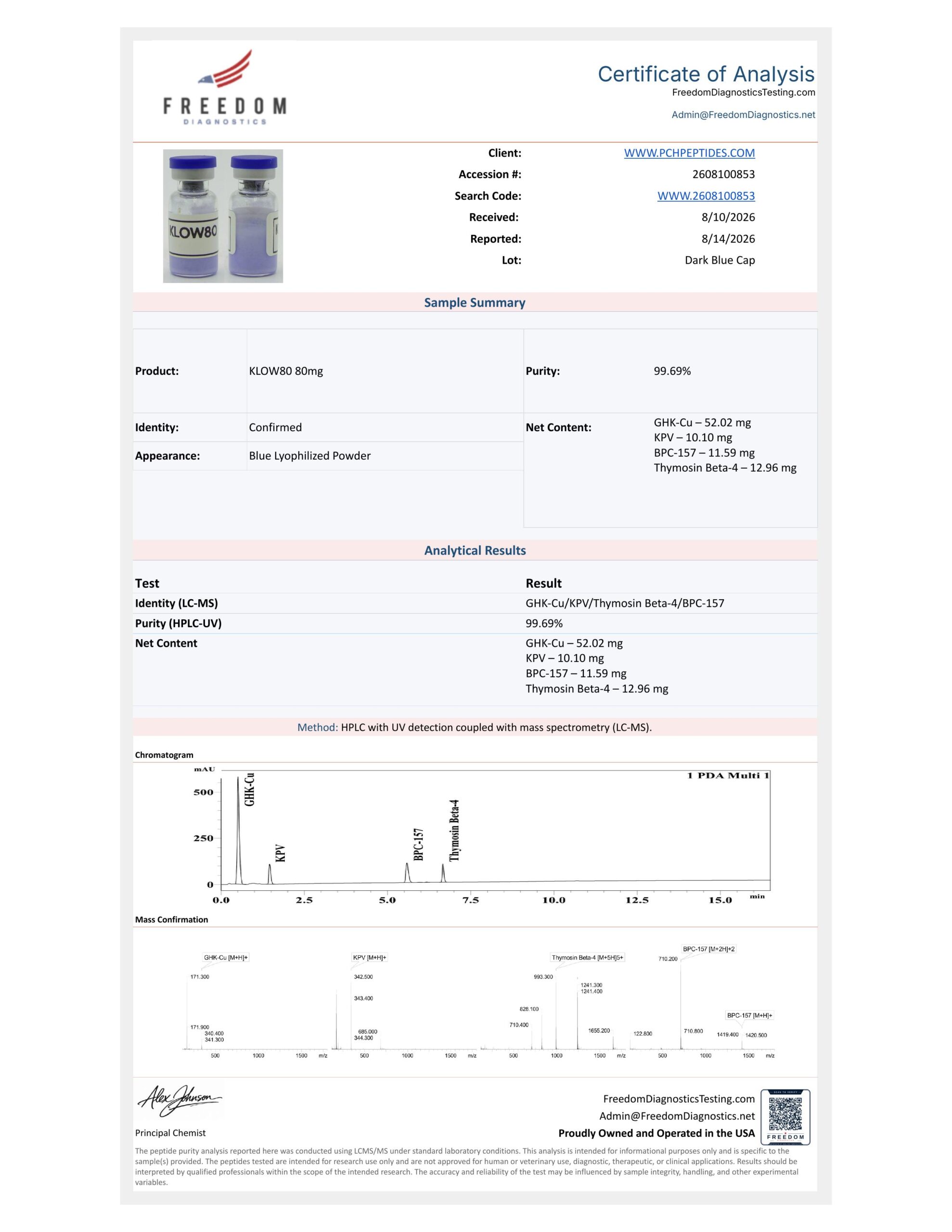
The PCH Peptides COA Library currently lists one Certificate of Analysis for KLOW Blend.
The submitted HPLC purity figure for the 80mg formulation is 99.69%.
Researchers should confirm this value against the applicable batch Certificate of Analysis before relying on it as a verified analytical result.
The current batch documentation should be reviewed for component identity, analytical purity, lot identification and available testing findings.
For a four-component formulation, researchers should also determine whether the reported HPLC purity represents an overall chromatographic result or separate analytical measurements for each component.
A single reported percentage should not automatically be interpreted as confirming identical purity for all four peptides.
Available batch-specific records help laboratories assess material consistency and analytical quality.
For additional background on research-use material classifications and documentation, review the Research Use Only Peptides Guide.
Storage and Handling
Keep the KLOW Blend vial sealed until required for an authorized laboratory workflow.
Store the lyophilized formulation in a cold, dry environment protected from moisture, excessive heat and direct light.
Follow the storage temperature and handling recommendations printed on the product label and applicable batch-specific documentation.
Because KLOW Blend contains multiple peptide components, the stability and compatibility of the formulation should be evaluated according to the requirements of the intended laboratory study.
Appropriate storage conditions help maintain the integrity of research materials during handling and analytical investigation.
Avoid using material from containers with damaged packaging, broken seals or uncertain identification.
Reconstitution Solution is available separately for suitable laboratory research applications, subject to the requirements and compatibility of the intended analytical workflow.
Researchers seeking general educational information about lyophilized peptide preparation can review the article on how peptide reconstitution works.
Related Research Materials
Laboratories investigating peptide-metal interactions, molecular signalling and multi-component peptide formulations may examine the individual KLOW Blend components or compare them with other predefined research mixtures.
- GHK-Cu – A copper-binding tripeptide complex investigated in peptide-metal coordination, cellular signalling and molecular characterization research.
- BPC-157 – A synthetic pentadecapeptide investigated in laboratory models involving cellular interactions and tissue-associated molecular pathways.
- TB-500 – A thymosin beta-4-related research peptide examined in cellular structure, peptide characterization and molecular stability studies.
- KPV – A synthetic tripeptide associated with alpha-MSH sequence research and investigated in short-peptide chemistry and inflammatory signalling models.
- GLOW Blend – A three-component research formulation containing GHK-Cu 50mg, BPC-157 10mg and TB-500 10mg, providing 70mg of total lyophilized material.
The main compositional difference between KLOW Blend and GLOW Blend is the inclusion of 10mg KPV in the KLOW formulation.
Researchers requiring independent control over individual compounds can examine the standalone research materials, while predefined blends provide fixed component ratios for comparative analytical studies.
Browse additional materials in the PCH Peptides research peptide catalog.
Frequently Asked Questions
What is in the KLOW peptide blend?
KLOW Blend contains four research peptide components:
- GHK-Cu: 50mg
- BPC-157: 10mg
- TB-500: 10mg
- KPV: 10mg
Each vial provides a total of 80mg of lyophilized research material.
What is the difference between KLOW Blend and GLOW Blend?
KLOW Blend contains four components: GHK-Cu, BPC-157, TB-500 and KPV.
GLOW Blend contains the same first three compounds but does not include KPV.
KLOW Blend provides 80mg total material, while GLOW Blend contains 70mg.
The additional 10mg of KPV is the primary compositional difference between the two formulations.
What is KLOW Blend used for in research?
KLOW Blend is supplied for controlled, non-clinical laboratory research involving multi-component peptide characterization, chemical stability, molecular interactions and comparative analytical studies.
Its individual components are investigated in different experimental models involving cellular signalling, peptide-metal interactions and related molecular processes.
These research applications do not establish clinical effectiveness or safety for human use.
What is the ratio of peptides in KLOW Blend?
KLOW Blend contains GHK-Cu, BPC-157, TB-500 and KPV in a 50:10:10:10 ratio by weight.
This simplifies to a 5:1:1:1 ratio.
The total nominal amount of research material is 80mg per vial.
What purity is the KLOW Blend?
The submitted batch HPLC purity figure is 99.69%.
This percentage should be confirmed against the current 80mg batch Certificate of Analysis before publication.
Researchers should also review the analytical method used and whether the report provides separate results for the individual components.
Available documentation can be accessed through the COA Library.
Can I buy the KLOW Blend components separately?
Yes. PCH Peptides lists all four compounds individually.
Researchers can access GHK-Cu, BPC-157, TB-500 and KPV as standalone research materials.
Separate products allow laboratories to evaluate individual compounds independently rather than using a predefined four-component formulation.
What is KPV in KLOW Blend?
KPV is a synthetic tripeptide consisting of lysine, proline and valine.
It corresponds to the C-terminal Lys-Pro-Val sequence associated with alpha-melanocyte-stimulating hormone.
Researchers investigate KPV in short-peptide chemistry, molecular characterization and laboratory models involving inflammatory signalling.
Its inclusion distinguishes KLOW Blend from the three-component GLOW formulation.
Is KLOW Blend batch tested?
The PCH Peptides COA Library lists one Certificate of Analysis for KLOW Blend.
Researchers should review the applicable batch report to confirm the available identity testing, purity measurements and analytical findings.
Because the formulation contains four distinct components, the report should also be examined to determine how each compound was identified and evaluated.
How should KLOW Blend be stored?
KLOW Blend should remain sealed and protected from moisture, excessive heat and direct light.
Follow the storage temperature and handling instructions provided on the product label and any applicable batch-specific documentation.
Appropriate storage is important for maintaining the integrity of multi-component research materials.
Is KLOW Blend intended for human or animal use?
No. KLOW Blend is supplied strictly for laboratory, academic and institutional research.
It is not intended for human or animal consumption, injection, therapeutic applications, diagnosis or veterinary use.
For additional information about research material classifications, read the Research Use Only Peptides Guide.
Do you provide dosage instructions for KLOW Blend?
No. PCH Peptides does not provide dosage, administration or usage protocols. KLOW Blend is supplied exclusively for qualified research use only.