
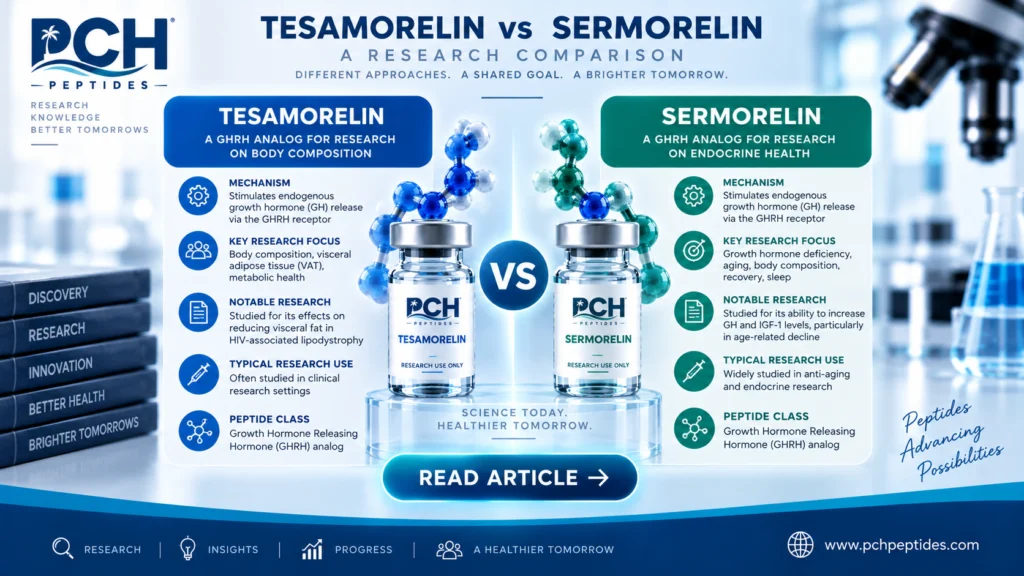
Tesamorelin and Sermorelin are two peptide compounds frequently discussed in research involving growth hormone-releasing hormone, commonly abbreviated as GHRH. Although both belong to the same broad research category, they are not identical molecules and should not be treated as interchangeable laboratory materials.
For researchers examining Tesamorelin vs Sermorelin, the most useful comparison begins with molecular structure, GHRH receptor activity, peptide stability, analytical characteristics, and the type of experimental question being investigated.
Tesamorelin is a stabilized synthetic analog of GHRH, while Sermorelin corresponds to a shorter 29-amino-acid sequence related to the naturally occurring human GHRH molecule. These structural differences can influence how each peptide behaves in experimental systems and how researchers design comparative studies.
PCH Peptides provides peptide materials strictly for laboratory, academic, and institutional research. Tesamorelin is currently available within the PCH Peptides research catalog, while Sermorelin is discussed here only as a scientific comparison compound.
What Is Tesamorelin in Research?
Tesamorelin is a synthetic analog of growth hormone-releasing hormone. In controlled research environments, it may be investigated in studies involving GHRH receptor interactions, peptide stability, endocrine signaling models, analytical characterization, and related metabolic pathways.
The structural design of Tesamorelin is intended to preserve GHRH-related biological activity while providing characteristics that distinguish it from naturally occurring GHRH and shorter analogs.
Researchers should separate these mechanistic and analytical observations from consumer-facing claims. A compound being studied within the GHRH pathway does not mean that Research Use Only material should be interpreted as an approved treatment or used outside qualified research environments.
Tesamorelin as a GHRH Analog
GHRH is a hypothalamic peptide involved in signaling associated with growth hormone release. Synthetic GHRH analogs are useful research tools because investigators can compare structural modifications with changes in receptor interaction, stability, metabolism, or analytical detection.
Tesamorelin research may therefore involve questions such as:
- GHRH receptor interaction
- Peptide stability under controlled conditions
- Molecular identification
- Chromatographic characteristics
- Signaling pathway analysis
- Metabolic research models
- Comparative peptide degradation
- Structure-activity relationships
Why Structural Modification Matters
Researchers studying peptide analogs often examine how small structural changes influence molecular behavior.
A modification can potentially affect enzymatic degradation, stability, receptor affinity, or detection characteristics. This makes Tesamorelin research useful for comparative work involving other GHRH-related peptides.
What Is Sermorelin in Research?
Sermorelin is a synthetic peptide corresponding to the first 29 amino acids of human growth hormone-releasing hormone.
It is often described scientifically as GHRH(1-29)-NH2. This sequence represents the biologically active N-terminal portion of the larger naturally occurring GHRH molecule.
Because Sermorelin has a different structure from Tesamorelin, the two compounds may show different stability, degradation, and analytical properties even though both are associated with GHRH receptor research.
Sermorelin and GHRH(1-29)
The relationship between Sermorelin and natural GHRH is one of the major points researchers consider when comparing Sermorelin vs Tesamorelin research.
Sermorelin contains 29 amino acids corresponding to the active N-terminal region of GHRH. Researchers have historically studied this shorter sequence to better understand GHRH signaling and peptide structure-activity relationships.
Why the Shorter Sequence Is Important
Peptide length and sequence can influence laboratory behavior.
When comparing GHRH analogs, researchers may examine:
- Molecular mass
- Amino-acid sequence
- Stability
- Enzymatic degradation
- Analytical retention time
- Receptor interaction
- Metabolic products
- Experimental reproducibility
These variables make precise identification important when designing a Tesamorelin vs Sermorelin study.
Tesamorelin vs Sermorelin: Key Research Differences
The most obvious difference between Tesamorelin and Sermorelin is their molecular structure.
Sermorelin is based on GHRH(1-29), while Tesamorelin is a modified GHRH analog designed with structural features that differentiate it from the shorter native-sequence fragment.
Comparing Their Research Characteristics
| Research Characteristic | Tesamorelin | Sermorelin |
| Research category | Synthetic GHRH analog | Synthetic GHRH fragment analog |
| GHRH relationship | Stabilized analog | Corresponds to GHRH(1-29) |
| Amino-acid context | Modified GHRH-related sequence | 29-amino-acid GHRH fragment |
| Primary research interest | GHRH signaling, stability, metabolic models | GHRH signaling, structure-activity studies |
| Molecular identity | Distinct from Sermorelin | Distinct from Tesamorelin |
| PCH Peptides listing | Currently listed | Not currently listed |
| Intended discussion here | Research only | Research comparison only |
This comparison does not establish that one peptide is superior to the other. The appropriate compound depends entirely on the research hypothesis.
Stability as a Research Variable
One of the most important distinctions researchers may investigate is peptide stability.
Sermorelin, as a GHRH(1-29) analog, has historically been associated with relatively rapid enzymatic degradation. Tesamorelin includes structural modification intended to alter properties of the GHRH molecule.
This difference can make stability a useful variable in controlled Tesamorelin vs Sermorelin research.
Stability Does Not Equal Overall Research Superiority
A more stable molecule is not automatically the better experimental choice.
If a laboratory is studying the properties of GHRH(1-29), Sermorelin may be the scientifically relevant comparison. If the research question concerns a modified GHRH analog, Tesamorelin may be more appropriate.
Experimental relevance should guide material selection.
How Tesamorelin and Sermorelin Relate to GHRH Research
Both compounds are closely connected to GHRH biology, which explains why they are often compared.
Researchers studying GHRH-related pathways may be interested in how different peptide structures influence receptor interaction and downstream experimental measurements.
GHRH Receptor Research
The GHRH receptor belongs to the broader family of G protein-coupled receptors.
Laboratory investigations involving GHRH analogs can examine how structurally different peptides interact with this receptor or influence measurable signaling endpoints in appropriate research models.
Researchers should clearly document which peptide was tested because different GHRH analogs cannot automatically be assumed to produce identical experimental behavior.
Maintain Model-Specific Interpretation
Results from cell culture, biochemical assays, animal research, or analytical testing should remain tied to the specific model in which the findings were generated.
A receptor-binding result does not automatically demonstrate a clinical outcome, and preclinical findings should not be presented as proof of human benefit.
Tesamorelin vs Sermorelin in Analytical Research
Analytical characterization is another useful area for comparing these peptides.
Because Tesamorelin and Sermorelin have different molecular structures, researchers can distinguish them using appropriately validated laboratory methods.
High-Performance Liquid Chromatography
High-performance liquid chromatography, or HPLC, is commonly used in peptide research to assess chromatographic purity and sample characteristics.
A Tesamorelin sample and a Sermorelin sample would not necessarily produce identical retention behavior because molecular differences affect their interactions with chromatographic systems.
Purity Is Only One Part of Characterization
Researchers should avoid treating a purity percentage as the complete description of a peptide.
Good research documentation may also include:
- Molecular identity
- Batch number
- Analytical method
- Mass confirmation
- Testing date
- Storage conditions
- Sample preparation information
- Relevant impurity data
Mass Spectrometry
Mass spectrometry can support peptide identification by providing molecular mass information.
Modern analytical research has used mass spectrometry techniques to distinguish multiple GHRH analogs, including Tesamorelin and Sermorelin.
Molecular Identity Matters in Comparative Studies
Researchers conducting a Tesamorelin vs Sermorelin comparison should confirm that the tested materials match their stated molecular identities.
Accurate identification reduces the risk of attributing experimental findings to the wrong compound.
Tesamorelin Research Material and Current Cost
Laboratory procurement requires more than comparing peptide names. Researchers often need to consider configuration, available documentation, current cost, and suitability for the intended experiment.
PCH Peptides currently lists its Tesamorelin 10 mg research material at $90.
Researchers can review the current Tesamorelin 10 mg research listing for live pricing, product configuration, availability, and research-use information.
Because research material pricing may change over time, the live product page should be considered the current pricing source.
PCH Peptides does not currently provide a Sermorelin product page within its research catalog, so researchers should not assume a PCH Peptides Sermorelin price or availability based on the Tesamorelin listing.
Why Certificates of Analysis Matter
A Certificate of Analysis, commonly called a COA, is an important part of peptide research documentation.
It allows researchers to review available batch-specific analytical information instead of relying only on a general product description.
PCH Peptides maintains a dedicated COA Library containing available analytical documentation for its research materials, including Tesamorelin.
What Researchers Should Check
When examining a peptide COA, useful information can include:
- Product identity
- Lot or batch number
- Purity result
- Analytical method
- Molecular characterization
- Test date
- Laboratory details where supplied
Match the COA to the Actual Material
Researchers should confirm that documentation corresponds to the batch used in the study.
Batch-specific traceability is particularly valuable when experiments need to be repeated, audited, or reproduced by another laboratory.
Choosing Between Tesamorelin and Sermorelin for Research
There is no universal answer to whether Tesamorelin or Sermorelin is more appropriate for research.
The decision depends on the experimental objective.
Questions Researchers Should Ask
Before selecting a GHRH-related peptide, consider:
- Is the project examining GHRH(1-29)?
- Is a structurally modified GHRH analog required?
- Is peptide stability an experimental variable?
- Will degradation products be measured?
- Is receptor interaction being investigated?
- Does the study require comparative analytical characterization?
- Is batch-specific documentation available?
- Are appropriate control materials included?
The answers can help determine whether Tesamorelin, Sermorelin, or another GHRH-related material is relevant.
Avoid Selecting Peptides Based on Popularity
Scientific material selection should follow the research question, not consumer discussion or online trends.
Peptides that appear frequently in the same search results may have significantly different molecular structures and experimental applications.
Tesamorelin Compared With Other Research Peptides
Researchers studying GHRH pathways may also encounter other materials with different structures and mechanisms.
For example, PCH Peptides supplies CJC-1295 No DAC research material and Ipamorelin research material.
These compounds should not automatically be grouped together simply because they are discussed in growth hormone-related research.
GHRH Analogs and Secretagogues Are Not Identical Categories
Tesamorelin and CJC-1295 are generally discussed within GHRH analog research, while Ipamorelin belongs to a different peptide research category involving growth hormone secretagogue receptor pathways.
Terminology Improves Scientific Accuracy
Researchers should identify peptide categories precisely rather than using broad terms such as “growth hormone peptides” as though all compounds have the same molecular target.
Clear terminology makes research reports easier to understand and reproduce.
Research Documentation at PCH Peptides
PCH Peptides provides several resources for laboratories evaluating peptide research materials.
Researchers can explore the broader research peptide catalog or consult the list of research peptides to review available compounds.
Educational information can also be found in the PCH Peptides research articles.
Research Use Classification
Researchers who need additional clarification about laboratory-only classification can review the PCH Peptides guide to Research Use Only peptides.
Questions About Documentation
For questions involving batch records, product documentation, orders, or research material availability, researchers can use the PCH Peptides contact page.
Requests involving human dosage, administration, cycles, therapeutic protocols, or personal use fall outside the intended scope of Research Use Only materials.
Research Use Only Disclaimer
All peptides discussed in this article are referenced solely for laboratory, analytical, academic, institutional, or preclinical research purposes.
PCH Peptides research materials are Research Use Only and are not intended for human or animal consumption, injection, ingestion, diagnosis, treatment, prevention, rehabilitation, performance enhancement, weight management, anti-aging use, or other therapeutic applications.
This article does not provide dosage guidance, reconstitution instructions, administration protocols, cycles, stacks, or medical advice.
Researchers should follow applicable laboratory procedures, institutional requirements, validated experimental methods, and appropriate safety practices.
Frequently Asked Questions About Tesamorelin vs Sermorelin
What is the primary difference between Tesamorelin and Sermorelin?
The primary difference is molecular structure. Sermorelin corresponds to the 29-amino-acid active portion of human GHRH, while Tesamorelin is a structurally modified synthetic GHRH analog.
Are Tesamorelin and Sermorelin the same peptide?
No. They are separate molecular entities. Both are associated with GHRH research, but their structures and analytical properties differ.
Is Tesamorelin a GHRH analog?
Yes. Tesamorelin is classified as a synthetic analog of growth hormone-releasing hormone and is studied in laboratory models involving GHRH receptor activity and related pathways.
What is Sermorelin in research?
Sermorelin is a synthetic peptide corresponding to GHRH(1-29), the biologically active N-terminal portion of human GHRH. Researchers have studied it in relation to receptor signaling, peptide degradation, and GHRH structure-activity relationships.
Which is more stable in Tesamorelin vs Sermorelin research?
Tesamorelin was designed as a modified GHRH analog with structural characteristics that distinguish it from GHRH(1-29). Stability should still be measured under the actual experimental conditions rather than assumed from peptide classification alone.
Does PCH Peptides currently offer Tesamorelin?
Yes. PCH Peptides currently lists a 10 mg Tesamorelin Research Use Only material in its catalog.
What does Tesamorelin cost for research?
At the time this article was prepared, the PCH Peptides 10 mg Tesamorelin research configuration was listed at $90. Researchers should confirm current information on the Tesamorelin research product page because pricing and availability can change.
Does PCH Peptides currently list Sermorelin?
PCH Peptides does not currently list Sermorelin in its live research catalog. For that reason, no PCH Peptides Sermorelin price or product link is provided in this comparison.
Is a Tesamorelin COA available?
Yes. Researchers can review available Tesamorelin documentation through the PCH Peptides COA Library.
Can results from Tesamorelin and Sermorelin research be compared directly?
They can be compared when the experimental design supports a direct comparison. Researchers should control variables carefully and account for differences in molecular identity, stability, analytical behavior, experimental concentration, and model selection.
Final Research Perspective
The Tesamorelin vs Sermorelin comparison is most useful when researchers focus on molecular differences rather than treating both compounds as interchangeable GHRH peptides.
Sermorelin represents the 29-amino-acid active portion of human GHRH, while Tesamorelin is a modified synthetic GHRH analog. Both can contribute to research involving receptor signaling, peptide stability, analytical detection, and structure-activity relationships, but their distinct molecular characteristics may lead researchers to ask different experimental questions.
For laboratories evaluating Tesamorelin research material, PCH Peptides currently provides a 10 mg configuration along with access to available batch documentation. Researchers can review the live product listing, consult the COA Library, or explore the broader PCH Peptides research catalog for related laboratory materials.
Ultimately, the correct peptide should be chosen according to the research hypothesis, analytical requirements, experimental model, and available documentation. Careful identification and model-specific interpretation are essential for producing meaningful and reproducible peptide research.