Research Use Only Disclaimer
PT-141 is sold strictly for laboratory, academic and institutional research. It is not for human or animal consumption, injection, or any therapeutic, diagnostic or veterinary use.
PCH Peptides does not provide dosage, administration or usage guidance.
Bremelanotide is also the active ingredient in an FDA-approved prescription medication. The research-grade material offered here must not be represented as an approved pharmaceutical product. Research-use-only labeling does not independently establish regulatory authorization for its sale or distribution.
What Is PT-141?
PT-141, also known as Bremelanotide, is a synthetic cyclic heptapeptide derived from research involving alpha-melanocyte-stimulating hormone (alpha-MSH) analogues.
It was developed from Melanotan II, another synthetic cyclic peptide investigated for its interactions with melanocortin receptors.
PT-141 contains a lactam-based cyclic structure that distinguishes it from linear peptide sequences and contributes to its molecular stability characteristics.
The peptide belongs to the melanocortin receptor agonist class and is investigated for its interactions with several melanocortin receptor subtypes, particularly MC3R and MC4R.
Melanocortin receptors are G protein-coupled receptors involved in multiple cellular signalling pathways.
Researchers investigate PT-141 in biochemical and molecular models involving ligand-receptor interactions, receptor activation, peptide structure and signalling mechanisms.
Its cyclic structure also makes it relevant to comparative studies involving linear and cyclic peptide analogues.
For additional educational information about peptide structures and classifications, explore the What Are Peptides? Research Guide.
PT-141 10mg Specifications
| Property | Value |
| Product name | PT-141 |
| Also known as | Bremelanotide |
| Compound type | Synthetic cyclic heptapeptide |
| Parent peptide family | Alpha-melanocyte-stimulating hormone (alpha-MSH) analogues |
| Structure | Ac-Nle-cyclo[Asp-His-D-Phe-Arg-Trp-Lys]-OH |
| Cyclization | Lactam ring |
| Molecular formula | C50H68N14O10 |
| Molecular weight | Approximately 1025.2 g/mol |
| Primary receptor targets studied | Melanocortin receptors, particularly MC3R and MC4R |
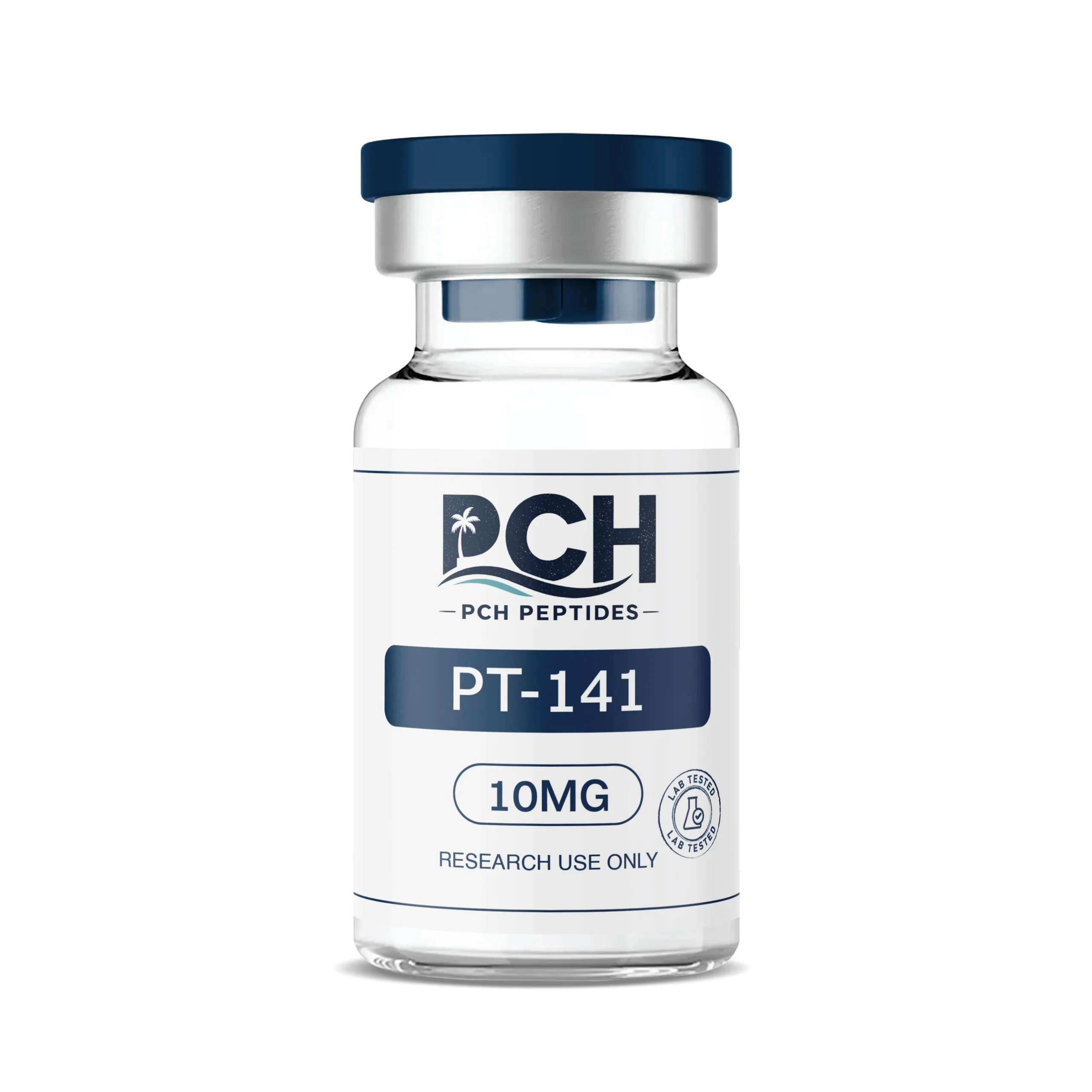
| Amount per vial | 10mg |
| Form | Lyophilized powder |
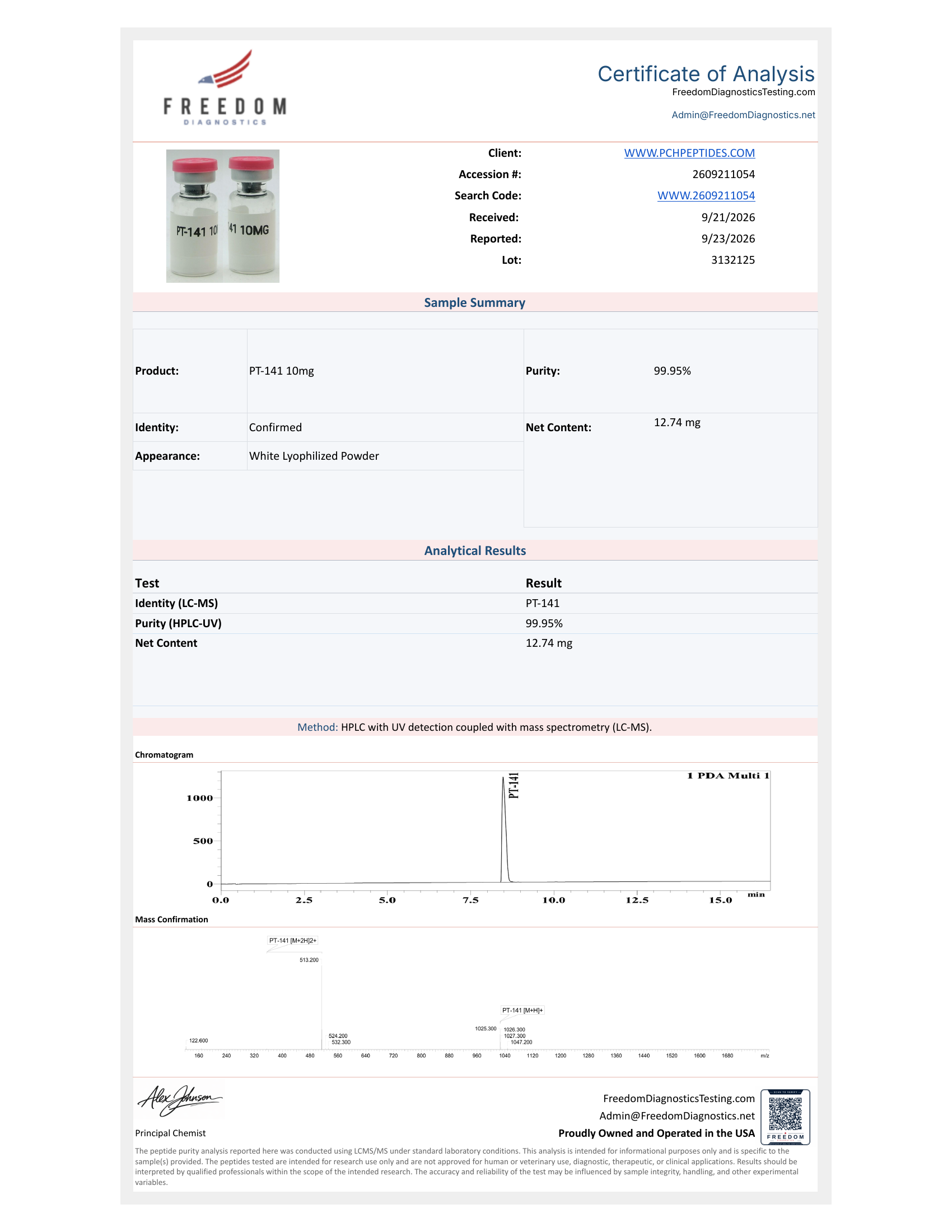
| Purity | 99.95% |
PT-141 in Laboratory Research
PT-141 is investigated in laboratory models involving melanocortin receptor binding, molecular signalling, cyclic peptide characterization and receptor selectivity.
Melanocortin Receptor Binding
Melanocortin receptors belong to a family of G protein-coupled receptors with five recognized subtypes, MC1R through MC5R.
PT-141 is investigated for its agonist activity at multiple melanocortin receptors, including MC3R and MC4R.
Researchers use biochemical assays and receptor-expression models to characterize its binding properties and receptor activation profile.
Experimental studies may examine ligand affinity, receptor activation and downstream intracellular signalling responses.
The compound’s receptor interactions are also compared with those of other synthetic alpha-MSH analogues.
MC3R and MC4R Signalling Research
MC3R and MC4R are melanocortin receptor subtypes investigated in neuroendocrine and cellular signalling research.
PT-141 is studied in controlled experimental systems involving receptor-mediated molecular interactions.
Researchers may examine changes in receptor activity and associated signalling pathways using appropriate biochemical and cellular models.
These studies contribute to the characterization of melanocortin receptor agonists and their structural properties.
Laboratory research findings should not be interpreted as evidence that research-grade PT-141 is safe or appropriate for human administration.
Cyclic Peptide Structure and Stability
PT-141 contains a cyclic peptide structure formed through an intramolecular lactam linkage.
Cyclization can influence peptide conformation, susceptibility to enzymatic degradation and receptor-binding characteristics.
Researchers investigate these structural features through analytical chemistry, peptide stability studies and molecular characterization.
Comparative studies may examine differences between cyclic melanocortin analogues and related linear peptide sequences.
Alpha-MSH Analogue Research
Alpha-melanocyte-stimulating hormone is a naturally occurring peptide derived from the proopiomelanocortin precursor protein.
Synthetic analogues of alpha-MSH are investigated to characterize how structural modifications influence melanocortin receptor interactions.
PT-141 is one such analogue, developed through research involving Melanotan II.
Researchers compare these compounds to examine differences in molecular structure, receptor selectivity and signalling behaviour.
Another alpha-MSH-related research peptide available through PCH Peptides is KPV, a short tripeptide corresponding to the C-terminal sequence of alpha-MSH.
Certificate of Analysis
PCH Peptides provides batch-specific analytical documentation for its PT-141 research material.
The PCH Peptides COA Library currently lists one Certificate of Analysis and one endotoxin report for PT-141.
Researchers should review the applicable batch Certificate of Analysis to confirm compound identity, HPLC purity and other available analytical findings.
The exact purity percentage should be taken directly from the current batch documentation rather than assumed from general product specifications.
The endotoxin report should be reviewed separately because endotoxin testing and HPLC purity testing assess different material characteristics.
Batch-specific documentation supports laboratory quality assessment, analytical verification and material traceability.
For additional information about research material classifications and documentation, review the Research Use Only Peptides Guide.
Storage and Handling
Keep the PT-141 vial sealed until required for an authorized laboratory workflow.
Store the lyophilized material in a cold, dry environment protected from moisture, excessive heat and direct light.
Follow the storage temperature and handling recommendations provided on the product label and applicable batch-specific documentation.
Appropriate storage conditions help maintain the integrity of synthetic cyclic peptides during laboratory handling.
Avoid using material from containers with damaged packaging, broken seals or uncertain identification.
Reconstitution Solution is available separately for compatible, authorized laboratory workflows. Diluent compatibility should be established by the laboratory rather than assumed.
Researchers seeking general information about lyophilized peptide preparation can review the educational article on how peptide reconstitution works.
Related Research Materials
Laboratories investigating neuropeptide chemistry, receptor-ligand interactions and cellular signalling may also examine related research compounds.
- Kisspeptin-10 – A synthetic decapeptide investigated for its interaction with the KISS1 receptor (GPR54) and its involvement in neuroendocrine signalling research.
- KPV – A synthetic tripeptide containing the sequence Lys-Pro-Val, corresponding to the C-terminal region of alpha-MSH. It is investigated in short-peptide chemistry and cellular signalling models.
- DSIP – Delta Sleep-Inducing Peptide, a synthetic nonapeptide investigated in neuropeptide chemistry, molecular characterization and peptide stability research.
Although these compounds are investigated in overlapping areas of neuropeptide research, their molecular structures and receptor interactions differ.
PT-141 is associated with melanocortin receptor agonism, while Kisspeptin-10 interacts with the KISS1 receptor.
KPV is derived from the alpha-MSH sequence but should not be assumed to have the same melanocortin receptor activity as PT-141.
Researchers can explore additional compounds through the PCH Peptides research catalog.
Frequently Asked Questions
Is PT-141 the same as Bremelanotide?
Yes. PT-141 is the original research designation for Bremelanotide, a synthetic cyclic heptapeptide associated with melanocortin receptor agonism.
Bremelanotide is also an active ingredient in an FDA-approved prescription medication. However, PCH Peptides’ research-grade PT-141 should not be confused with an approved pharmaceutical formulation.
Which receptors does PT-141 act on?
PT-141 acts as an agonist at multiple melanocortin receptor subtypes, with particular research interest in MC3R and MC4R.
Researchers investigate these receptor interactions through controlled biochemical and molecular signalling assays.
Its precise receptor activity depends on the experimental system and analytical conditions.
What is PT-141 used for in research?
PT-141 is investigated in laboratory studies involving melanocortin receptor binding, receptor activation, peptide structure, molecular characterization and signalling pathways.
Researchers also compare its properties with other synthetic alpha-MSH analogues.
These laboratory applications do not establish the safety or effectiveness of research-grade PT-141 for human use.
How is PT-141 related to Melanotan II?
PT-141 was developed from Melanotan II, a synthetic cyclic alpha-MSH analogue.
Both compounds have related cyclic peptide structures and are investigated for melanocortin receptor interactions.
Their molecular structures differ, including differences associated with their terminal regions.
Researchers compare these analogues in controlled laboratory models to examine how structural modifications influence receptor activity and molecular behaviour.
What is the molecular weight of PT-141?
PT-141 has an approximate molecular weight of 1025.2 g/mol and a molecular formula of C50H68N14O10.
These specifications refer to the Bremelanotide peptide structure. Any formulation-specific salt or counterion information should be confirmed against the applicable batch documentation.
Is PT-141 a cyclic peptide?
Yes. PT-141 is a synthetic cyclic heptapeptide containing an intramolecular lactam linkage.
Its cyclic structure distinguishes it from linear peptides and is relevant to laboratory studies involving peptide conformation, molecular stability and receptor interactions.
What size does PT-141 come in?
PCH Peptides supplies PT-141 as a 10mg lyophilized research material in a single vial.
The product is listed for qualified laboratory, academic and institutional research only.
Is PT-141 batch tested?
The PCH Peptides COA Library lists one Certificate of Analysis and one endotoxin report for PT-141.
Researchers should review the applicable batch documentation to verify compound identity, purity and available analytical findings.
The documentation can be accessed through the COA Library.
How should PT-141 be stored?
PT-141 should remain sealed and protected from moisture, excessive heat and direct light.
Follow the temperature and handling recommendations printed on the product label and any applicable batch-specific documentation.
Appropriate storage helps maintain the integrity of lyophilized peptide research materials.
Is PT-141 intended for human or animal use?
No. PCH Peptides lists this PT-141 material strictly for laboratory, academic and institutional research.
It is not intended for human or animal consumption, injection, diagnosis, treatment or veterinary use.
Although Bremelanotide is used in an FDA-approved prescription medication, research-grade material is not equivalent to an approved pharmaceutical product.
For additional information about research-use classifications, review the Research Use Only Peptides Guide.
Do you provide dosage instructions for PT-141?
No. PCH Peptides does not provide dosage, administration or usage protocols. Its PT-141 material is supplied exclusively for qualified research use only.